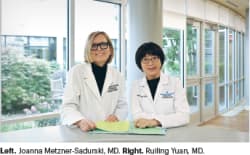
October filled our calendars with patient care, community outreach, and health policy work. It also gave us time together on rural South Carolina roads, talking about our patients, sharing ideas, and reflecting on the communities we serve.
One Sunday morning, we were heading to a church for a breast cancer awareness and cancer prevention event. The sky was bright blue, the autumn air was crisp, and the countryside was turning gold, amber, and red. In the historic downtown of Ninety Six, South Carolina, a fountain glowed pink for Breast Cancer Awareness Month.
When we arrived, the church was beautifully decorated, and women and families were dressed in pink for the occasion. There was music, laughter, and a warmth that made us feel immediately welcomed. We had come to share information and educate the group about breast cancer prevention and early detection. We had not expected how much the morning would teach us.
Seeing Our Patients Through Different Eyes
What touched us most was seeing familiar patients in a setting we rarely share with them. In the clinic, we know their diagnoses, treatment histories, laboratory results, and scans. We have sat beside them through difficult decisions and heard some of their deepest fears. That morning, we saw them smiling, celebrating, and sharing talents we had never known they possessed.
It made us wonder how much of a person’s life we miss when most of our time together is organized around an illness.
A clinic visit has a purpose, and time is limited. Even when we care deeply about our patients, there are parts of their lives we may never encounter in an examination room. On that particular Sunday, we were guests in their community. We had the opportunity to see our patients among the people and traditions that give their lives meaning.
We left knowing something more about the people we would care for on Monday morning.
The Value of Showing Up Together
Throughout October, we participated in several community events. Our partnership helps make this work possible. We bring different strengths, encourage one another, and turn conversations into ideas we can pursue together. The drives between events have become part of that experience, giving us time to think beyond the demands of the clinic.
Our schedules are full, and finding time for another commitment can be difficult. Yet these visits often leave us energized. We go hoping to contribute, and the welcome we receive gives us a renewed sense of purpose.
Showing up also changes our relationships with our patients. When they see us at church or a community gathering, there is room for conversations that might never happen during an office visit. We get to know one another in a different way.
Community outreach and health policy advocacy are closely connected for us. Time spent in our communities helps us understand what access to care means in daily life.
Transportation difficulties, lost income, and limited specialty services affect whether a patient can follow a treatment plan. A clinical trial may offer an important opportunity, yet repeated travel to a distant center can make participation impossible for a family.
Those realities come with us into policy discussions. We think about the patient traveling hours for a consultation and the family trying to balance work with treatment. We also remember the women in pink whom we met at church, and the lives they are hoping to continue living.
Our patients’ zip codes should never determine their opportunities to benefit from advances in cancer research and treatment. Listening to their experiences helps us recognize where change is needed and explain why it matters.
The Power of One Opportunity
Many community oncologists want to contribute to research, education, and health policy. With busy practices and countless responsibilities, knowing where to begin can be difficult. Sometimes an invitation from someone who believes in you makes the difference.
For both of us, Jasmine Kamboj, MD, FASCO has been that person. Dr. Kamboj is a medical oncologist and hematologist at Northfield Hospital + Clinics, Northfield, Minnesota. She leads ASCO’s Communities of Practice Policy and served as Congress President for the first Community Oncology Global Congress (COGC 2026)—a virtual program that took place in late August 2026. COGC 2026 focused on why community oncology must have a central place in the future of cancer care. As community oncologists, the messages Dr. Kamboj shared during the Congress were inspirational.
One opportunity led to another. Along the way, our friendship and partnership grew through a shared commitment to patients and advocacy. Dr. Kamboj’s willingness to include and encourage us helped set that work in motion. Her mentorship helped us recognize that our experiences in community oncology have value beyond our own clinics, and that the challenges we encounter every day belong in broader conversations about cancer care.
We wonder how many colleagues have the same desire to participate but are waiting for an invitation or a little guidance. An introduction, a conversation, or a word of encouragement can help someone take a first step.
Having received that support, we want to offer it to others. Mentorship continues when the people who were encouraged begin creating opportunities for someone else.
The Road Ahead
Community oncology means delivering high-quality cancer care close to home. It also means understanding what home means to the people we care for. One patient, one community, one opportunity, one conversation, and one mile at a time. ν
Drs. Metzner-Sadurski and Yuan are medical oncologists/hematologists at Self Regional Healthcare, Greenwood, South Carolina.