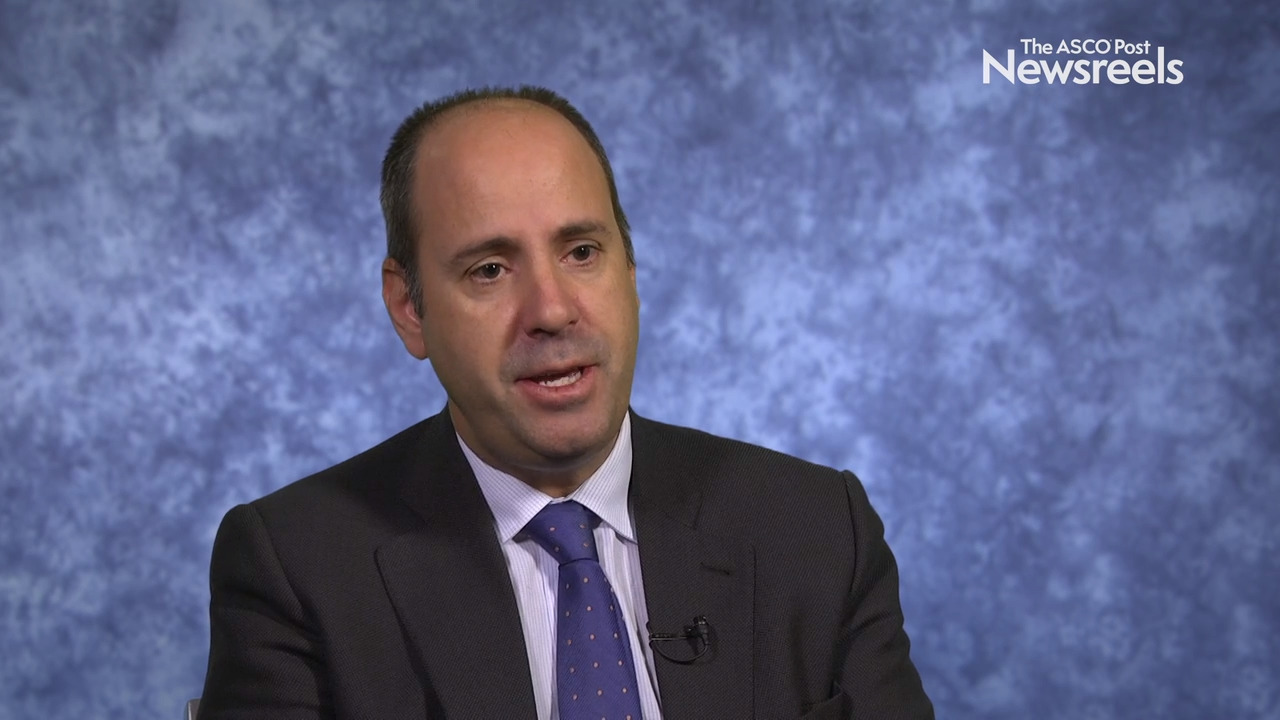
Miguel Martín, MD, PhD, on Metastatic Breast Cancer: PEARL Trial on Palbociclib Plus Endocrine Therapy vs Capecitabine
2019 San Antonio Breast Cancer Symposium
Miguel Martín, MD, PhD, of the Gregorio Marañón Institute and GEICAM, discusses phase III study findings that showed no improvement in progression-free survival with palbociclib plus endocrine therapy vs capecitabine in patients with hormone receptor–positive/HER2-negative metastatic breast cancer whose disease progressed on aromatase inhibitors—although the drug combination was generally better tolerated than capecitabine (Abstract GS2-07).
Javier Cortes, MD, PhD, of the IOB Institute of Oncology, discusses study findings that suggested pembrolizumab offered a prolonged survival benefit compared to chemotherapy for a subset of patients with previously treated metastatic triple-negative breast cancer. In the trial, high tumor-infiltrating lymphocytes were significantly associated with better clinical outcomes with the checkpoint inhibitor.
Milan Radovich, PhD, of Indiana University School of Medicine, discusses trial findings that show patients with triple-negative breast cancer who are at high risk of relapse after receiving preoperative chemotherapy can be risk-stratified based on the presence of minimal residual disease as determined by circulating tumor DNA and circulating tumor cells (Abstract GS5-02).
Rowan T. Chlebowski, MD, PhD, of the Lundquist Institute at Harbor-UCLA Medical Center, discusses the long-term influence of using estrogen plus progestin or estrogen alone on breast cancer incidence and mortality (Abstract GS5-00).
Ian E. Krop, MD, PhD, of Dana-Farber Cancer Institute, discusses phase II trial findings on trastuzumab deruxtecan, a HER2-targeting antibody-drug conjugate, in patients with HER2-positive metastatic breast cancer who were previously treated with trastuzumab emtansine (Abstract GS1-03).
Ralph R. Weichselbaum, MD, of the University of Chicago, summarizes a plenary lecture in which he presented data that could guide future clinical strategies: studies supporting the basis and classification of oligometastatic disease, including breast cancer; and basic and clinical data on radioimmunotherapy (Abstract PL2).