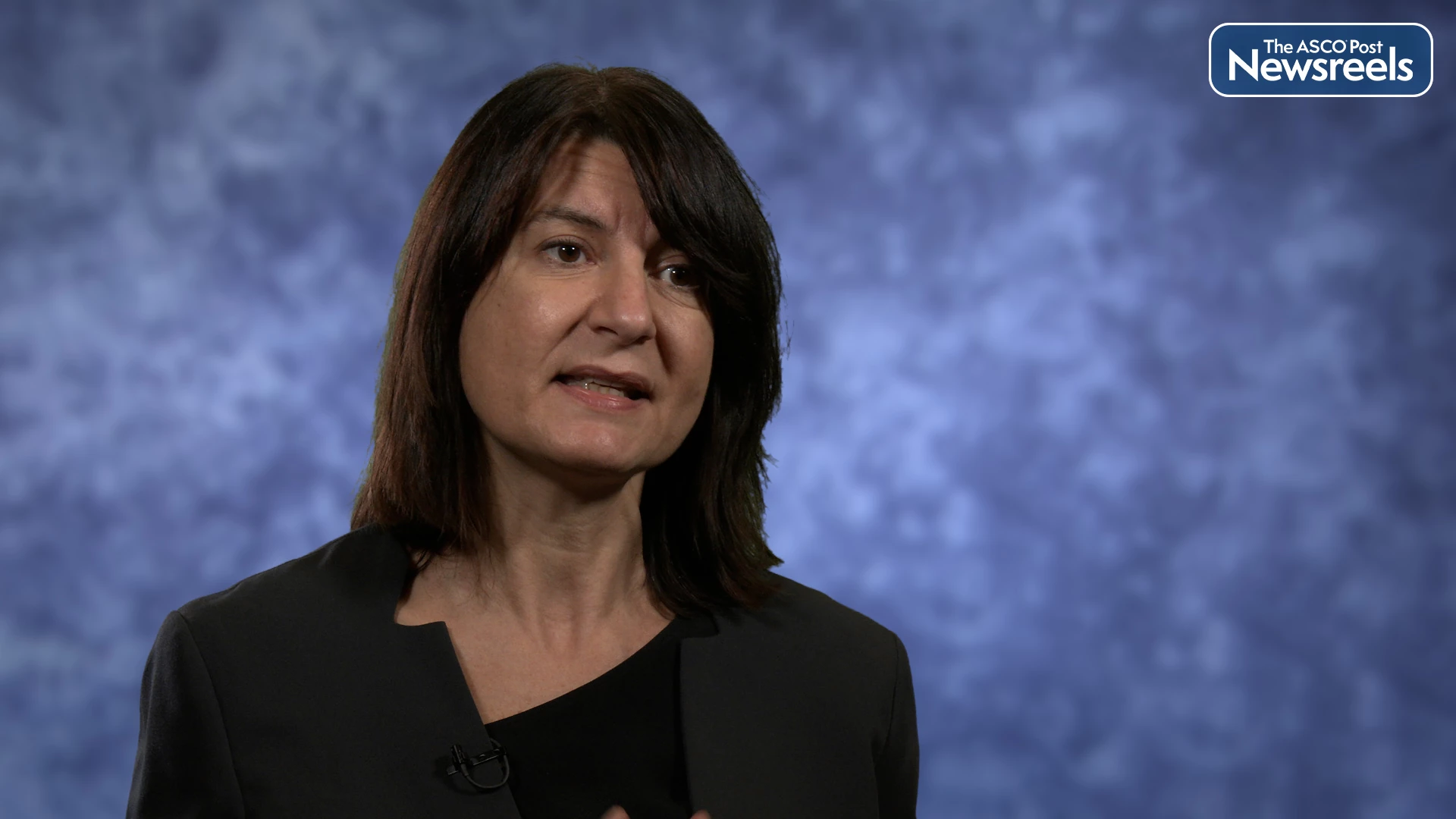
Nicholas C. Turner, MD, PhD, on High-Risk Early-Stage Breast Cancer: Profiling Primary Tumors
2023 SABCS
Nicholas C. Turner, MD, PhD, of The Royal Marsden Hospital NHS Foundation Trust, and the Institute of Cancer Research, London, discusses the monarchE trial, which evaluated molecular profiling of archived primary tumor tissue from patients with hormone receptor–positive, HER2-negative, node-positive, high-risk early-stage breast cancer and its potential association with clinical outcomes. Adjuvant abemaciclib plus endocrine therapy (ET) maintained invasive disease–free survival benefit compared with ET alone across all molecular subtypes as measured by RNA sequencing (Abstract GS03-06).
Related Videos
The ASCO Post Staff
Daniel G. Stover, MD, of The Ohio State University Comprehensive Cancer Center, discusses a biomarker analysis from the PALLAS adjuvant trial, which compared 2 years of the CDK4/6 inhibitor palbociclib with endocrine therapy vs endocrine therapy alone, as adjuvant treatment for patients with stage II–III hormone receptor–positive, HER2-negative breast cancer. The genomic subtype PAM50 was defined in the protocol of the PALLAS trial as the primary biomarker for analysis of prediction and prognosis (Abstract GS03-07).
The ASCO Post Staff
Barbara Pistilli, MD, of France’s Gustave Roussy, discusses a phase Ib analysis from the CAPItello-292 study, which showed capivasertib plus palbociclib plus fulvestrant was tolerable at all dose levels in heavily pretreated patients with hormone receptor–positive, HER2-negative advanced breast cancer. As data collection continues, evidence of clinical activity has been observed in patients treated with the recommended phase III dose (Abstract PS12-09).
The ASCO Post Staff
Cynthia X. Ma, MD, PhD, of Washington University School of Medicine in St. Louis, discusses phase I findings showing the safety and tolerability of copanlisib and fulvestrant in combination with continuous or intermittent abemaciclib in patients with estrogen receptor–positive, HER2-negative metastatic breast cancer. Preliminary antitumor activity, which was observed, will be further examined in the phase II trial (ClinicalTrials.gov identifier NCT03939897) (Abstract PS17-06).
The ASCO Post Staff
Sara A. Hurvitz, MD, of Fred Hutchinson Cancer Research Center, University of Washington, discusses phase III findings of the HER2CLIMB-02 study, which showed the combination of tucatinib and trastuzumab emtansine improved progression-free survival in patients with previously treated, HER2-positive, locally advanced or metastatic breast cancer (including those with brain metastases) (Abstract GS01-10).
The ASCO Post Staff
Aditya Bardia, MD, MPH, of Massachusetts General Hospital Cancer Center, discusses phase III findings from the KEYNOTE-756 study, which showed that adding pembrolizumab to chemotherapy increases the pathologic complete response rate and lowers the residual cancer burden in patients with early-stage, high-risk ER-positive or HER2-negative breast cancer (Abstract GS01-02).