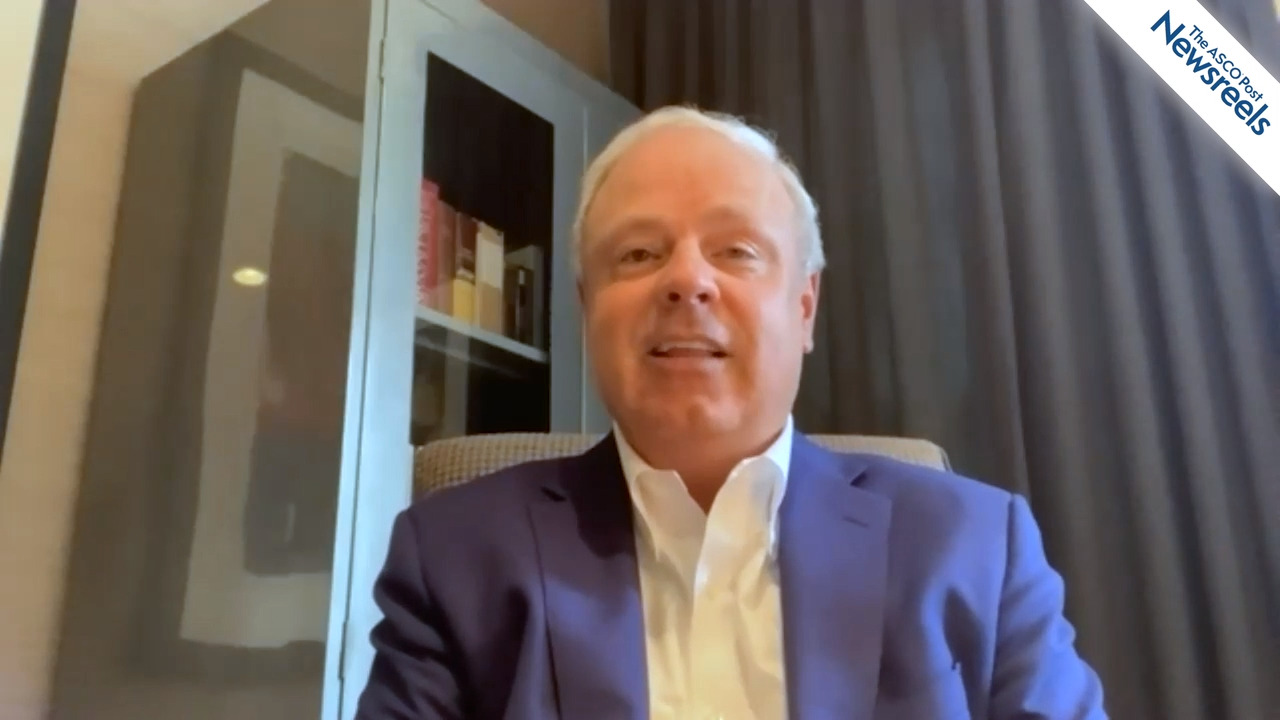
Nikhil C. Munshi, MD, on Multiple Myeloma: Idecabtagene Vicleucel in Patients With Relapsed or Refractory Disease
ASCO20 Virtual Scientific Program
Nikhil C. Munshi, MD, of Dana-Farber Cancer Institute, discusses initial results from the KarMMa tria, showing that idecabtagene vicleucel, a B-cell maturation antigen-targeted CAR T-cell therapy, demonstrated deep and durable responses in patients with heavily pretreated relapsed or refractory multiple myeloma. Efficacy and safety data support a favorable clinical benefit-risk profile across the target dose range (Abstract 8503).
The ASCO Post Staff
Seema A. Khan, MD, MPH, of the Lynn Sage Comprehensive Breast Center, discusses phase III trial results showing that in newly diagnosed metastatic stage IV breast cancer, locoregional treatment of the primary tumor did not offer a greater survival benefit than systemic therapy (Abstract LBA2).
The ASCO Post Staff
Howard A. Burris III, MD, FACP, FASCO, Immediate Past President of ASCO and current Society Board Chair, talks about how the meeting went, with its record-breaking attendance and new format.
The ASCO Post Staff
Sara A. Hurvitz, MD, of UCLA’s David Geffen School of Medicine, summarizes four breast cancer studies: KATHERINE, on adjuvant trastuzumab vs trastuzumab in patients with residual invasive disease after neoadjuvant therapy for HER2-positive breast cancer; KAITLIN, on trastuzumab emtansine and pertuzumab vs trastuzumab, pertuzumab, and taxane after anthracyclines as adjuvant therapy for high-risk HER2-positive early breast cancer; TRAIN-2, on neoadjuvant chemotherapy with or without anthracyclines for HER2-positive disease; and PHERGain, on chemotherapy de-escalation using an FDG-PET/CT and pathologic response–adapted strategy in HER2-positive early breast cancer (Abstracts 500, 501, 502, and 503).
The ASCO Post Staff
Eric Zhou, PhD, of Dana-Farber Cancer Institute, discusses an existing online program called SHUTi (Sleep Healthy Using the Internet), that he and his team adapted to the needs of adolescent and young adult cancer survivors. After six online cognitive behavior therapy sessions delivered over 8 weeks, the 22 patients in the study reported a significant reduction in insomnia severity, daytime sleepiness, and fatigue as well as an overall improvement in quality of life.
The ASCO Post Staff
David R. Wise, MD, PhD, of New York University Perlmutter Cancer Center, summarizes three important studies in prostate cancer: circulating tumor cell count as a prognostic marker of PSA response and progression in metastatic castration-sensitive disease; new phenotypic subtypes; and how circulating tumor DNA dynamics associate with treatment response and radiologic progression-free survival (Abstracts 5506, 5507, and 5508).