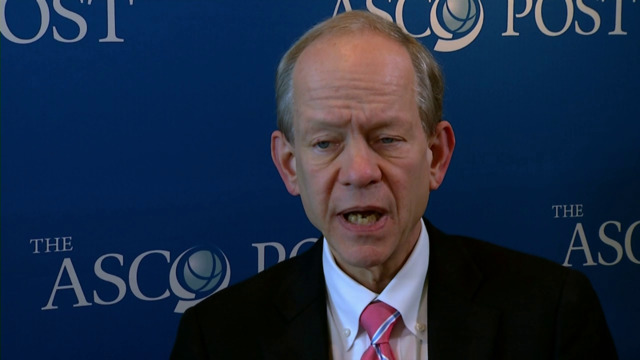
Wui-Jin Koh, MD, on Making NCCN Guidelines Relevant Around the Globe
2015 NCCN Annual Conference
Wui-Jin Koh, MD, of the Fred Hutchinson Cancer Research Center and the Seattle Cancer Care Alliance, discusses the program to adapt NCCN guidelines to regions of the world with different resource availability. The first guideline to be adapted in this way is for cervical cancer, which is prevalent in the developing world.
Mary Lou Smith, JD, MBA
Mary Lou Smith, JD, MBA, of the Research Advocacy Network, discusses, from the perspective of a patient advocate, the value of the NCCN guidelines and the impact they have made on cancer care.
Ingrid A. Mayer, MD
Ingrid A. Mayer, MD, of the Vanderbilt-Ingram Cancer Center, discusses the evolution of endocrine therapy for metastatic breast cancer.
Gregory A. Otterson, MD
Gregory A. Otterson, MD, of The Ohio State University Comprehensive Cancer Center and the James Cancer Hospital and Solove Research Institute, discusses the evolution of lung cancer treatment from adjuvant chemotherapy to immunotherapy and the clinical trials underway.
Andrew J. Armstrong, MD, ScM
Andrew J. Armstrong, MD, ScM, of Duke Cancer Institute, discusses the recent practice-changing landmark studies that showed significant increases in survival for men with castration-resistant prostate cancer and led to updates in the NCCN Guidelines for this disease.
John A. Thompson, MD
John A. Thompson, MD, of the Fred Hutchinson Cancer Research Center and Seattle Cancer Care Alliance, discusses the latest immunotherapeutics for advanced melanoma, including pembrolizumab, trametinib, nivolumab, and dabrafenib.