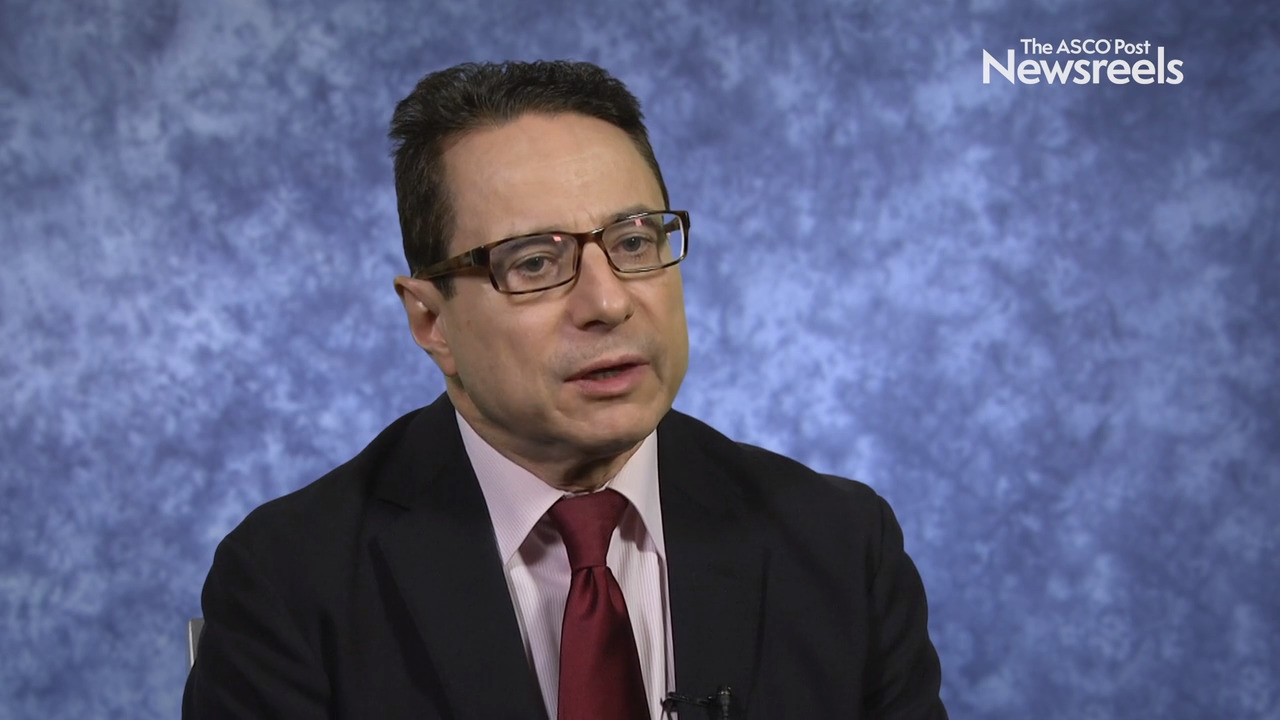
Javier Cortes, MD, PhD, on Triple-Negative Breast Cancer: Results From the KEYNOTE-119 Trial of Pembrolizumab vs Chemotherapy
2019 San Antonio Breast Cancer Symposium
Javier Cortes, MD, PhD, of the IOB Institute of Oncology, discusses study findings that suggested pembrolizumab offered a prolonged survival benefit compared to chemotherapy for a subset of patients with previously treated metastatic triple-negative breast cancer. In the trial, high tumor-infiltrating lymphocytes were significantly associated with better clinical outcomes with the checkpoint inhibitor.
Tari A. King, MD, of Brigham and Women’s Hospital and Dana-Farber/ Brigham and Women’s Cancer Center, discusses retrospective findings from the AURORA U.S. Network on molecular differences between primary tumors and metastases, a better understanding of which may help lead to more effective treatment of metastatic breast cancer (Abstract GS3-08).
Miguel Martín, MD, PhD, of the Gregorio Marañón Institute and GEICAM, discusses phase III study findings that showed no improvement in progression-free survival with palbociclib plus endocrine therapy vs capecitabine in patients with hormone receptor–positive/HER2-negative metastatic breast cancer whose disease progressed on aromatase inhibitors—although the drug combination was generally better tolerated than capecitabine (Abstract GS2-07).
Milan Radovich, PhD, of Indiana University School of Medicine, discusses trial findings that show patients with triple-negative breast cancer who are at high risk of relapse after receiving preoperative chemotherapy can be risk-stratified based on the presence of minimal residual disease as determined by circulating tumor DNA and circulating tumor cells (Abstract GS5-02).
Ian E. Krop, MD, PhD, of Dana-Farber Cancer Institute, discusses phase II trial findings on trastuzumab deruxtecan, a HER2-targeting antibody-drug conjugate, in patients with HER2-positive metastatic breast cancer who were previously treated with trastuzumab emtansine (Abstract GS1-03).
Luca Gianni, MD, of the Fondazione Michelangelo, discusses findings from the NeoTRIP trial on pathologic complete response to neoadjuvant treatment with or without atezolizumab in triple-negative, early high-risk, and locally advanced breast cancer (Abstract GS3-04).