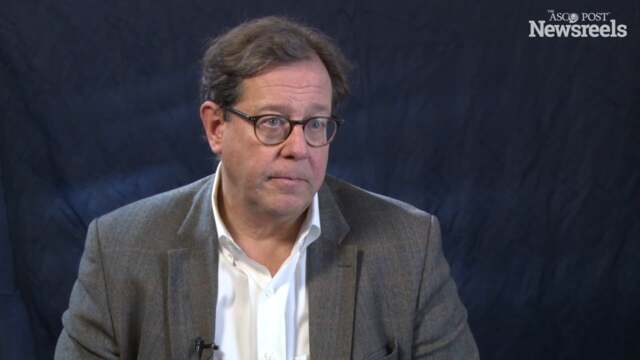
Clifford A. Hudis, MD, on Results of the TAILORx Clinical Trial
2015 European Cancer Congress
Clifford A. Hudis, MD, of Memorial Sloan Kettering Cancer Center, discusses this prospective study of endocrine therapy alone in patients with ER-positive, HER2-negative, node-negative breast cancer (Abstract 5BA).
Benjamin Besse, MD, PhD, and Tony Mok, MD
Benjamin Besse, MD, PhD, of the Institut Gustave Roussy, and Tony Mok, MD, of The Chinese University of Hong Kong, discuss this phase II trial of atezolizumab as first-line or subsequent therapy for locally advanced or metastatic PD-L1–selected NSCLC (Abstract 17LBA).
Martine Frouws, MSc, PhD
Martine Frouws, MD, PhD Candidate, of Leiden University Medical Centre discusses her study, which showed a significant increase in overall survival among patients with GI cancers who took aspirin compared to those who did not (Abstract 2306).
A. Oliver Sartor, MD
A. Oliver Sartor, MD, of Tulane University School of Medicine, discusses the latest results of a clinical trial on radium-223 dichloride and the improvement in overall survival of men with advanced prostate cancer (Abstracts 2510, 2530).
Rolf A. Stahel, MD
Rolf A. Stahel, MD, of University Hospital, Zurich, discusses this phase II trial of erlotinib and bevacizumab in patients with advanced, EGFR-mutated non-small cell lung cancer without T790M mutation. The study was sponsored by The Spanish Lung Cancer Group and the European Thoracic Oncology Platform (Abstract 3BA).
Martine J. Piccart-Gebhart, MD, PhD
Martine J. Piccart-Gebhart, MD, PhD, of the Jules Bordet Institute, and ECCO President, discusses ways in which imaging can form the solution to individualized cancer treatment.