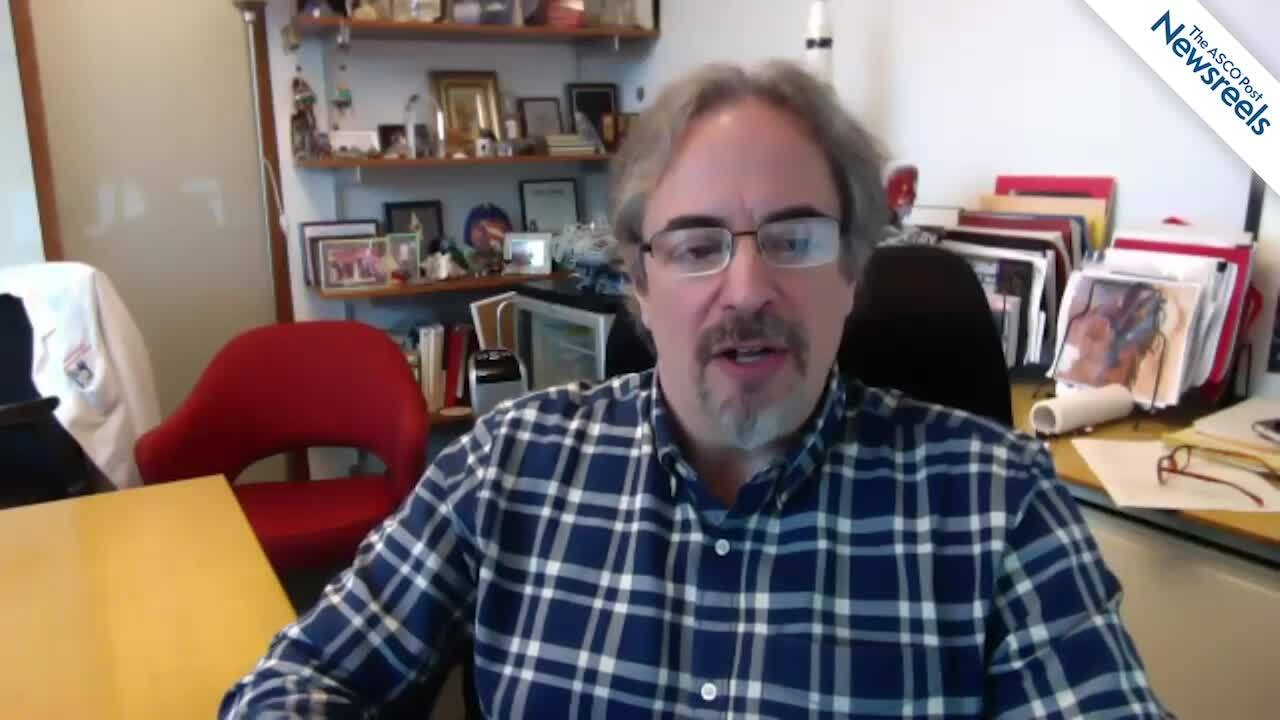
Jyoti Nangalia, MBBChir, on MPN: A New Paradigm for the Development of Blood Cancer?
2020 ASH Annual Meeting & Exposition
Jyoti Nangalia, MBBChir, of Wellcome Sanger Institute and the University of Cambridge, discusses how her team used large-scale whole-genome sequencing to precisely time the origins of a blood cancer and measure how it grew. The information could provide opportunities for early diagnosis and intervention (Abstract LBA-1).
The ASCO Post Staff
Caron A. Jacobson, MD, of the Dana-Farber Cancer Institute, discusses results from the ZUMA-9 C2 study, an ongoing trial that is exploring axicabtagene ciloleucel in patients with relapsed or refractory large B-cell lymphoma (Abstract 2100).
The ASCO Post Staff
Andrew D. Zelenetz, MD, PhD, of Memorial Sloan Kettering Cancer Center, discusses phase II results from a single-center study that explored a novel approach for high-risk patients with mantle cell lymphoma. Among patients with TP53 wild-type disease, the data suggested this treatment was effective (Abstract 119).
The ASCO Post Staff
Steven M. Horwitz, MD, of Memorial Sloan Kettering Cancer Center, discusses phase II data from the Primo trial, which support continued evaluation of duvelisib as a treatment option for relapsed or refractory peripheral T-cell lymphoma due to consistent response rates (Abstract 44).
The ASCO Post Staff
David T. Teachey, MD, of the University of Pennsylvania and Children’s Hospital of Philadelphia, discusses data showing that cranial radiation might be eliminated in most children with T-cell acute lymphoblastic leukemia and that bortezomib may improve survival in children with T-cell lymphoblastic lymphoma (Abstract 266).
The ASCO Post Staff
Ari M. Melnick, MD, of Weill Cornell Medicine, discusses the BCL10 mutation in patients with activated B-cell–like diffuse large B-cell lymphoma, and his study results which showed that the mutation should be considered as a biomarker for ibrutinib resistance so that alternative targeted treatments can be prioritized (Abstract 3).