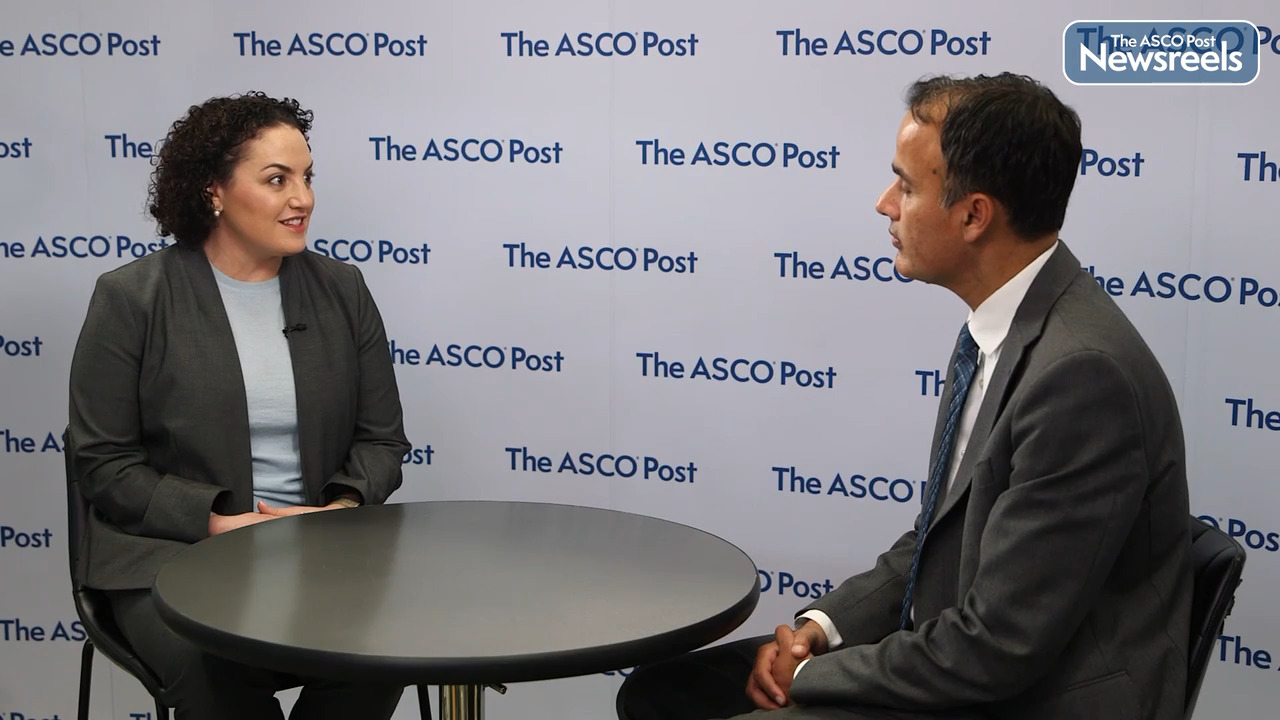
Aaron T. Gerds, MD, on Anemia in Myelofibrosis: New Data on Treatment With Luspatercept
2023 ASCO Annual Meeting
Aaron T. Gerds, MD, of Cleveland Clinic Taussig Cancer Institute, talks about treating the anemia many patients with myelofibrosis experience because of JAK inhibitor therapy. The ACE-536-MF-001 study showed that luspatercept improved anemia and transfusion burden in this population, with a safety profile consistent with that in previous studies (Abstract 7016).
The ASCO Post Staff
Alicia K. Morgans, MD, MPH, and Praful Ravi, MRCP, MBBChir, both of Dana-Farber Cancer Institute, discuss an individual patient-data analysis of randomized trials from the ICECAP collaborative. A PSA nadir of ≥ 0.1 ng/mL within 6 months after radiotherapy completion was prognostic for prostate cancer–specific, metastasis-free, and overall survival in patients receiving radiotherapy plus androgen-deprivation therapy for localized prostate cancer. These findings may help identify patients for therapy de-escalation trials (Abstract 5002).
The ASCO Post Staff
Guillermo Garcia-Manero, MD, of The University of Texas MD Anderson Cancer Center, discusses phase III findings from the COMMANDS trial. Compared with epoetin alfa, luspatercept improved red blood cell transfusion independence and erythroid response, as well as the duration of response in erythropoiesis-stimulating agent–naive, transfusion-dependent patients with lower‐risk myelodysplastic syndromes (Abstract 7003).
The ASCO Post Staff
Tycel J. Phillips, MD, and Alex F. Herrera, MD, both of the City of Hope National Medical Center, discuss results from the SWOG S1826 study, which showed that nivolumab and AVD (doxorubicin, vinblastine, and dacarbazine) improved progression-free survival vs brentuximab vedotin plus AVD in patients with advanced-stage classical Hodgkin lymphoma. Longer follow-up is needed to assess overall survival and patient-reported outcomes. This trial may be a key step toward harmonizing the pediatric and adult treatment of advanced-stage disease (LBA4).
The ASCO Post Staff
Allison Betof Warner, MD, PhD, of Stanford University Medical Center, and Adnan Khattak, MBBS, FRACP, PhD, of Australia’s Hollywood Private Hospital & Edith Cowan University, discuss the use of the mRNA-4157 vaccine in combination with pembrolizumab as adjuvant therapy for resected high-risk melanoma, which prolonged distant metastasis–free survival compared with pembrolizumab alone. These results provide further evidence that a personalized neoantigen approach is potentially beneficial (Abstract LBA9503).
The ASCO Post Staff
Sebastian Stintzing, MD, of the Charité Universitätsmedizin Berlin, discusses results from the phase III FIRE-4 study, which showed that liquid biopsy is clinically relevant in verifying mutational status in patients with metastatic colorectal cancer and is efficacious in first-line treatment of FOLFIRI and cetuximab for patients with RAS wild-type disease (Abstract 3507).