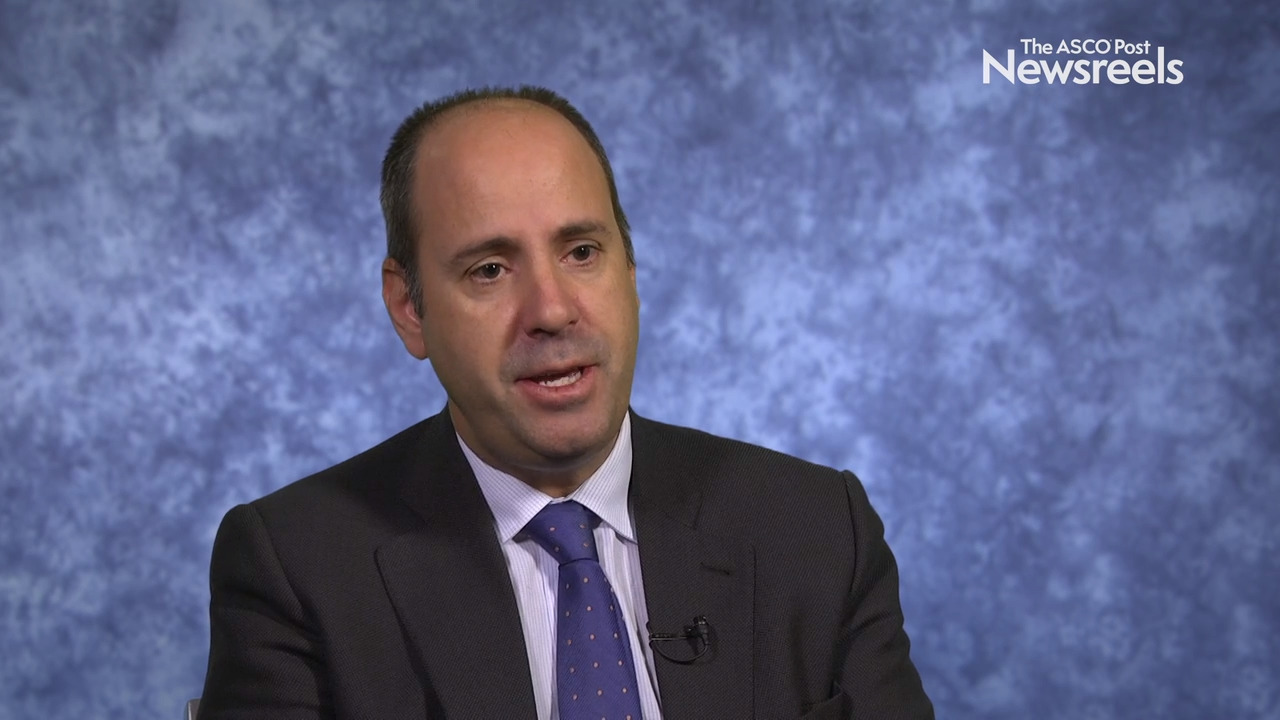
Milan Radovich, PhD, on ctDNA After Neoadjuvant Chemotherapy and Recurrence in Triple-Negative Breast Cancer
2019 San Antonio Breast Cancer Symposium
Milan Radovich, PhD, of Indiana University School of Medicine, discusses trial findings that show patients with triple-negative breast cancer who are at high risk of relapse after receiving preoperative chemotherapy can be risk-stratified based on the presence of minimal residual disease as determined by circulating tumor DNA and circulating tumor cells (Abstract GS5-02).
Nadine M. Tung, MD, of Beth Israel Deaconess Medical Center, discusses cisplatin vs doxorubicin/cyclophosphamide (AC) as neoadjuvant treatment in BRCA-mutation carriers with HER2-negative breast cancer. Although cisplatin as a single agent shows activity in this setting, the pathologic complete response with this agent alone is not higher than that with standard AC chemotherapy (Abstract GS6-03).
Hongchao Pan, PhD, of the University of Oxford, discusses an analysis of 86,000 women in the Early Breast Cancer Trialists’ Collaborative Group database, which showed that the risk of distant recurrence 20 years after a diagnosis of node-negative, estrogen receptor–negative early-stage breast cancer in women who discontinued endocrine therapy at 5 years is likely to be about a third lower now than in his group’s previous report (Abstract GS2-04).
Tari A. King, MD, of Brigham and Women’s Hospital and Dana-Farber/ Brigham and Women’s Cancer Center, discusses retrospective findings from the AURORA U.S. Network on molecular differences between primary tumors and metastases, a better understanding of which may help lead to more effective treatment of metastatic breast cancer (Abstract GS3-08).
Hope S. Rugo, MD, of the University of California San Francisco Comprehensive Cancer Center, discusses trial data on margetuximab plus chemotherapy, which improved progression-free survival in patients with previously treated HER2-positive metastatic breast cancer when compared with trastuzumab plus chemotherapy. Maturing data comparing overall survival also provides new insights (Abstract GS1-02).
Javier Cortes, MD, PhD, of the IOB Institute of Oncology, discusses study findings that suggested pembrolizumab offered a prolonged survival benefit compared to chemotherapy for a subset of patients with previously treated metastatic triple-negative breast cancer. In the trial, high tumor-infiltrating lymphocytes were significantly associated with better clinical outcomes with the checkpoint inhibitor.