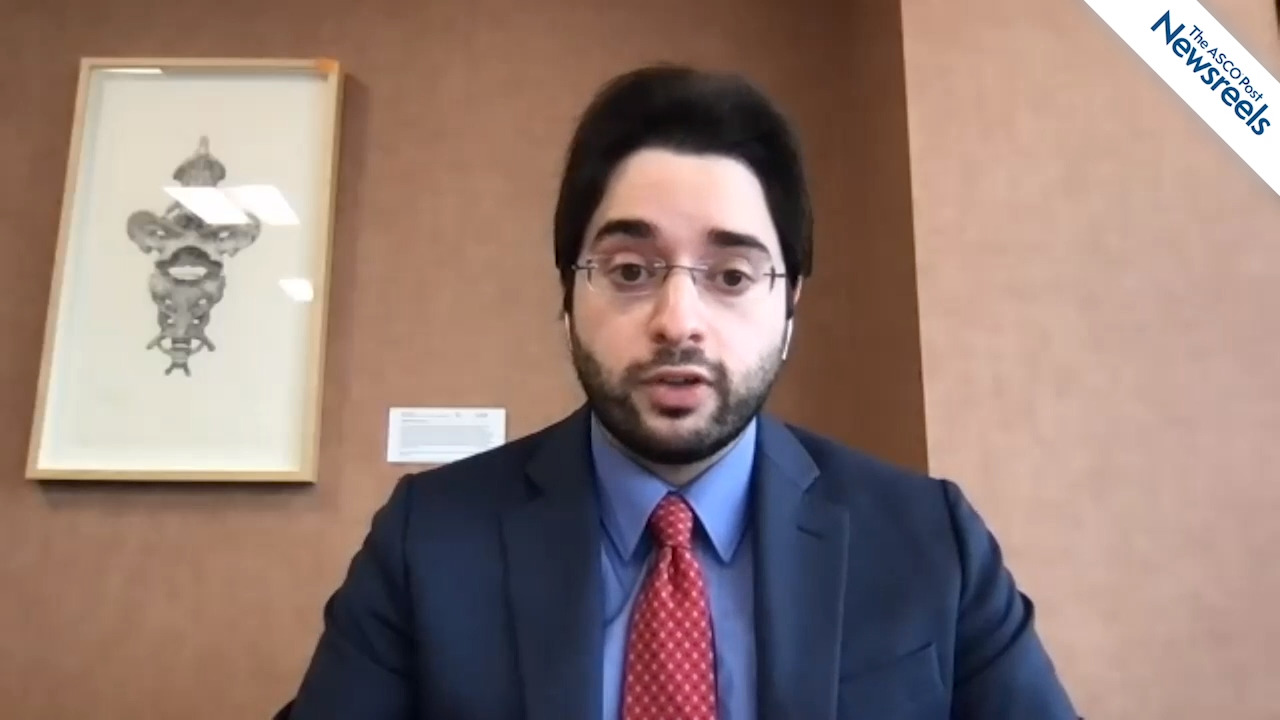
Steven M. Horwitz, MD, on PTCL: Update on Efficacy of Duvelisib Dose Optimization
2020 ASH Annual Meeting & Exposition
Steven M. Horwitz, MD, of Memorial Sloan Kettering Cancer Center, discusses phase II data from the Primo trial, which support continued evaluation of duvelisib as a treatment option for relapsed or refractory peripheral T-cell lymphoma due to consistent response rates (Abstract 44).
The ASCO Post Staff
David T. Teachey, MD, of the University of Pennsylvania and Children’s Hospital of Philadelphia, discusses data showing that cranial radiation might be eliminated in most children with T-cell acute lymphoblastic leukemia and that bortezomib may improve survival in children with T-cell lymphoblastic lymphoma (Abstract 266).
The ASCO Post Staff
Farhad Ravandi, MD, of The University of Texas MD Anderson Cancer Center, offers his expert perspective on key treatment studies in acute myeloid leukemia on the use of gilteritinib, consolidation chemotherapy, venetoclax, cladribine, azacitidine, quizartinib, decitabine, and CPX-351 (Session 616 [Abstracts 24- 29]).
The ASCO Post Staff
Meletios A. Dimopoulos, MD, of the University of Athens, discusses data from the phase III APOLLO study, which evaluated the use of subcutaneous daratumumab plus pomalidomide and dexamethasone, vs pomalidomide and dexamethasone alone, in patients with relapsed or refractory multiple myeloma (Abstract 412).
The ASCO Post Staff
Caron A. Jacobson, MD, of the Dana-Farber Cancer Institute, discusses results from the ZUMA-9 C2 study, an ongoing trial that is exploring axicabtagene ciloleucel in patients with relapsed or refractory large B-cell lymphoma (Abstract 2100).
The ASCO Post Staff
Hassan Awada, MD, of the Taussig Cancer Institute, Cleveland Clinic Foundation, discusses the use of newer machine-learning techniques to help decipher a set of prognostic subgroups that could predict survival, thus potentially improving on traditional methods and moving acute myeloid leukemia into the era of personalized medicine (Abstract 34).