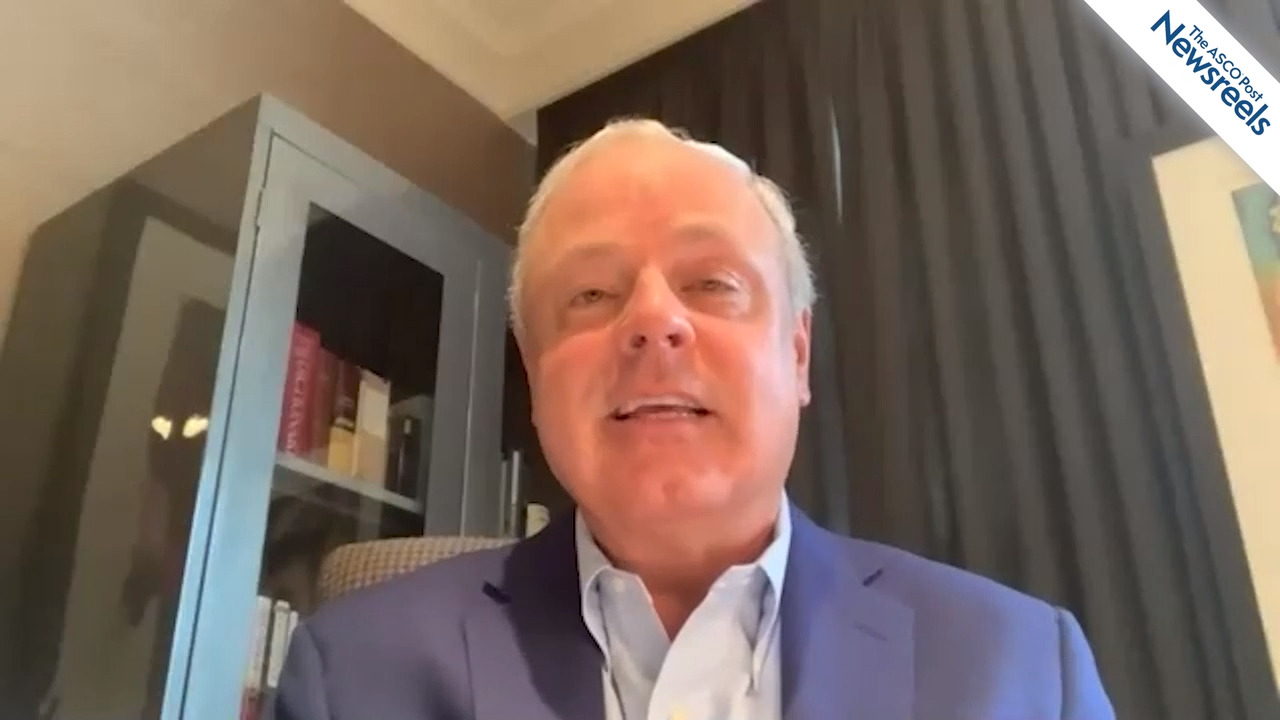
Welcome to This Year’s Meeting: A Message From ASCO President Howard A. Burris III, MD, FACP, FASCO
ASCO20 Virtual Scientific Program
Howard A. Burris III, MD, FACP, FASCO, President of ASCO, talks about what to expect from this year’s ASCO20 Virtual Scientific Program and its many offerings.
The ASCO Post Staff
Howard A. Burris III, MD, FACP, FASCO, talks about some of the reports of research developments he is looking forward to and how future conferences could incorporate virtual presentations.
The ASCO Post Staff
Parameswaran Hari, MD, of the Medical College of Wisconsin, discusses phase III data from a 6-year follow-up of the STaMINA trial, which compared progression-free survival among 758 patients with high-risk multiple myeloma who received a second autologous transplant and lenalidomide maintenance; consolidation with lenalidomide, bortezomib, and dexamethasone followed by lenalidomide maintenance; or lenalidomide maintenance alone (Abstract 8506).
The ASCO Post Staff
Rana R. McKay, MD, of the University of California, San Diego, discusses the results of a phase II trial of intense neoadjuvant hormone therapy followed by radical prostatectomy in men with high-risk prostate cancer. The data show that 21% of patients had a favorable pathologic response (Abstract 5503).
The ASCO Post Staff
Scott Kopetz, MD, PhD, of The University of Texas MD Anderson Cancer Center, discusses phase III results of the BEACON CRC study, which confirmed that, compared with standard chemotherapy, encorafenib plus cetuximab with or without binimetinib improved overall survival and objective response rate in previously treated patients with BRAF V600E–mutated metastatic colorectal cancer (Abstract 4001).
The ASCO Post Staff
Rachel E. Sanborn, MD, of the Providence Cancer Institute, discusses three key abstracts on EGFR-mutated non–small cell lung cancer: a final overall survival analysis of bevacizumab plus erlotinib; concurrent osimertinib plus gefitinib for first-line treatment; and first-line treatment with a tyrosine kinase inhibitor with or without aggressive upfront local radiation therapy (Abstracts 9506, 9507, 9508).