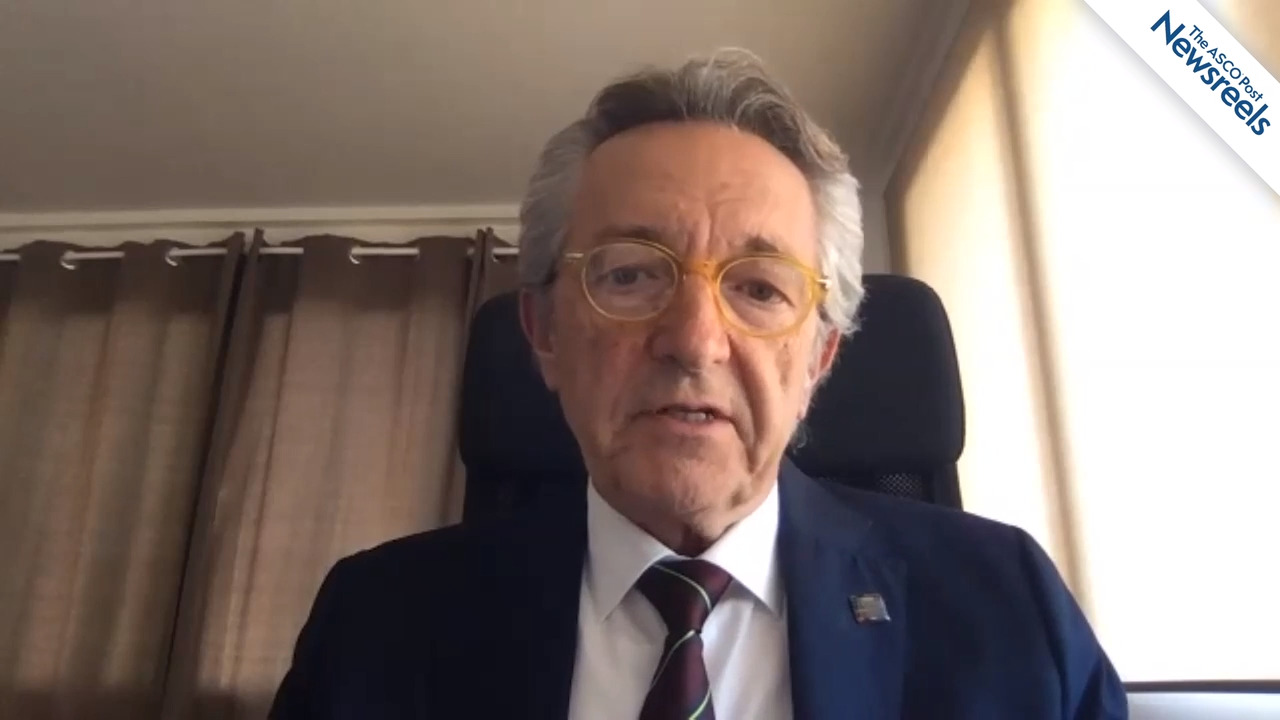
Fatima Cardoso, MD, on Breast Cancer: MammaPrint as Guidance for Adjuvant Chemotherapy
ASCO20 Virtual Scientific Program
Fatima Cardoso, MD, of Lisbon’s Champalimaud Cancer Center, discusses the long-term results of MINDACT, a large prospective trial showing the clinical utility of the 70-gene signature MammaPrint for adjuvant chemotherapy decision-making. The primary distant metastasis–free survival endpoint at 5 years continued to be met in chemotherapy-untreated women with clinical-high/genomic-low risk disease (Abstract 506).
The ASCO Post Staff
Christopher Sweeney, MBBS, of Dana-Farber Cancer Institute, talks with Thomas Powles, MD, PhD, of Queen Mary University of London, about the first study to demonstrate a survival advantage with avelumab for metastatic urothelial cancer. In the trial, avelumab improved median overall survival by 21.4 months compared with 14.3 months with best supportive care (Abstract LBA1).
The ASCO Post Staff
Daniel P. Petrylak, MD, of the Yale Cancer Center, discusses early data on ARV-110, an androgen receptor proteolysis–targeting chimera degrader, demonstrating antitumor activity in metastatic castration-resistant prostate cancer after treatment with enzalutamide and abiraterone (Abstract 3500).
The ASCO Post Staff
Leora Horn, MD, of Vanderbilt University, discusses the results of the TERAVOLT study, launched by the Thoracic Cancers International COVID-19 Collaboration. It examined the impact of specific chemotherapy and immunotherapy regimens on hospitalization and risk of death in patients with thoracic malignancies who are also infected with COVID-19 (Abstract LBA111).
The ASCO Post Staff
Eric Zhou, PhD, of Dana-Farber Cancer Institute, discusses an existing online program called SHUTi (Sleep Healthy Using the Internet), that he and his team adapted to the needs of adolescent and young adult cancer survivors. After six online cognitive behavior therapy sessions delivered over 8 weeks, the 22 patients in the study reported a significant reduction in insomnia severity, daytime sleepiness, and fatigue as well as an overall improvement in quality of life.
The ASCO Post Staff
Andres Poveda, MD, of Initia Oncology, discusses phase III results from the SOLO2 trial, which showed that, compared with placebo, maintenance olaparib improved median overall survival by 12.9 months in patients with platinum-sensitive, relapsed ovarian cancer and a BRCA mutation (Abstract 6002).