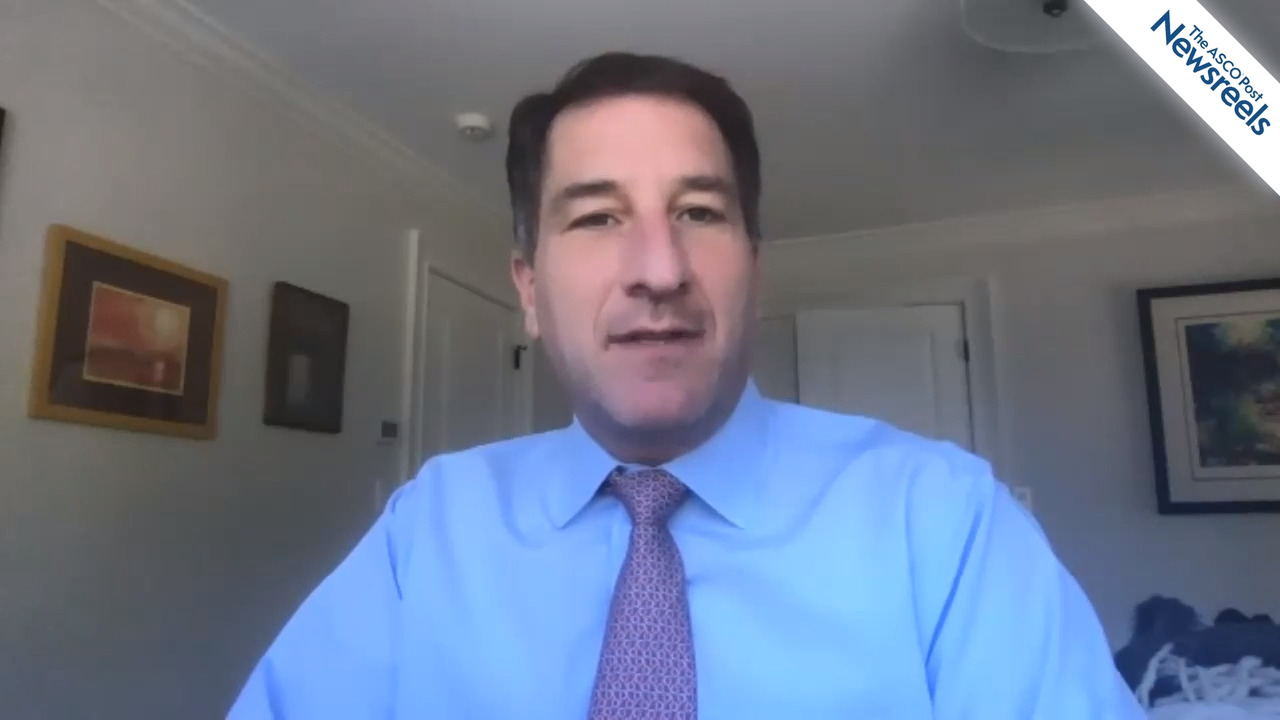
Paul G. Richardson, MD, on Multiple Myeloma: First-in-Human Study of the Novel Agent CC-92480
ASCO20 Virtual Scientific Program
Paul G. Richardson, MD, of Dana-Farber Cancer Institute, discusses early results on a cereblon E3 ligase modulator agent combined with dexamethasone in patients with relapsed or refractory multiple myeloma, with an overall response rate of 48%. The study is ongoing to further optimize dose and schedule (Abstract 8500).
The ASCO Post Staff
Neal D. Shore, MD, of the Carolina Urologic Research Center, discusses phase III results of the HERO study, which showed relugolix achieved castration as early as day 4 and was superior to leuprolide in sustained testosterone suppression, testosterone recovery after discontinuation, and reduction in cardiovascular side effects (Abstract 5602).
The ASCO Post Staff
Ursula A. Matulonis, MD, of Dana-Farber Cancer Institute, discusses three important studies focusing on newer therapies for patients with recurrent platinum-sensitive, platinum-agnostic, and advanced recurrent ovarian cancers (Abstracts 6003, 6004, and 6005).
The ASCO Post Staff
Nirav Niranjan Shah, MD, of the Medical College of Wisconsin, explores whether autologous transplantation, in patients with relapsed diffuse large B-cell lymphoma who achieve only a PET/CT-positive partial remission, is appropriate in the era of CAR T-cell therapy (Abstract 8000).
The ASCO Post Staff
Rachel E. Sanborn, MD, of the Providence Cancer Institute, discusses three key abstracts on EGFR-mutated non–small cell lung cancer: a final overall survival analysis of bevacizumab plus erlotinib; concurrent osimertinib plus gefitinib for first-line treatment; and first-line treatment with a tyrosine kinase inhibitor with or without aggressive upfront local radiation therapy (Abstracts 9506, 9507, 9508).
The ASCO Post Staff
Jeffrey A. Meyerhardt, MD, MPH, of Dana-Farber Cancer Institute, discusses results from the CALGB/SWOG 80702 trial of celecoxib plus standard adjuvant therapy with fluorouracil, leucovorin, and oxaliplatin (FOLFOX). Adding celecoxib to standard chemotherapy did not significantly improve disease-free or overall survival (Abstract 4003).