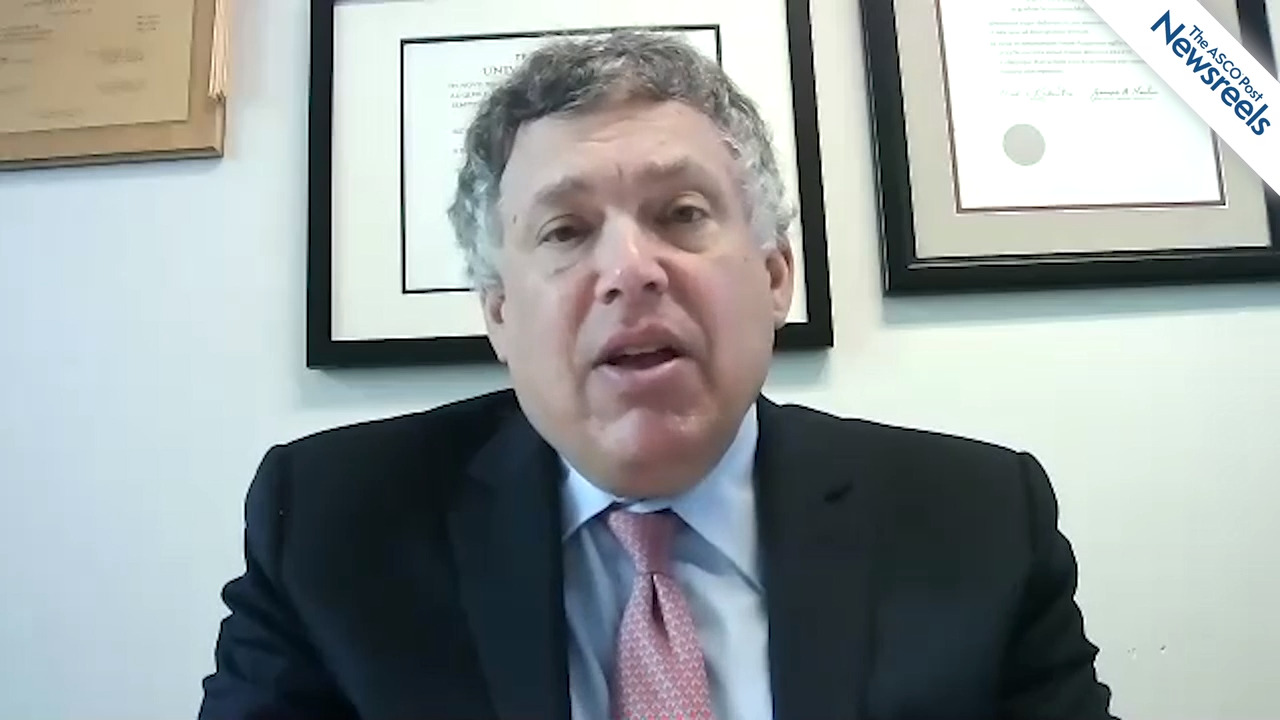
Richard L. Schilsky, MD, on This Year’s Practice-Changing Findings
ASCO20 Virtual Scientific Program
Richard L. Schilsky, MD, Chief Medical Officer of ASCO, talks about some of the most important and practice-changing findings presented this year at the ASCO20 Virtual Scientific Program, including the use of targeted and immunotherapies in earlier lines of therapy, where they have made a significant impact.
The ASCO Post Staff
Rana R. McKay, MD, of the University of California, San Diego, discusses the results of a phase II trial of intense neoadjuvant hormone therapy followed by radical prostatectomy in men with high-risk prostate cancer. The data show that 21% of patients had a favorable pathologic response (Abstract 5503).
The ASCO Post Staff
Michael J. Morris, MD, of Memorial Sloan Kettering Cancer Center, discusses phase III data from the CONDOR trial, which showed that PSMA-targeted PET scans detected and localized occult disease in most men with biochemically recurrent prostate cancer presenting with negative or equivocal conventional imaging findings (Abstract 5501).
The ASCO Post Staff
Rachel E. Sanborn, MD, of the Providence Cancer Institute, discusses three key abstracts on EGFR-mutated non–small cell lung cancer: a final overall survival analysis of bevacizumab plus erlotinib; concurrent osimertinib plus gefitinib for first-line treatment; and first-line treatment with a tyrosine kinase inhibitor with or without aggressive upfront local radiation therapy (Abstracts 9506, 9507, 9508).
The ASCO Post Staff
Roy S. Herbst, MD, PhD, of Yale Cancer Center, discusses data from the ADAURA study, which showed that compared with placebo, osimertinib as adjuvant therapy after complete tumor resection reduced the risk of disease recurrence or death by 79% in patients with non–small cell lung cancer (Abstract LBA5).
The ASCO Post Staff
Sara A. Hurvitz, MD, of UCLA’s David Geffen School of Medicine, summarizes four breast cancer studies: KATHERINE, on adjuvant trastuzumab vs trastuzumab in patients with residual invasive disease after neoadjuvant therapy for HER2-positive breast cancer; KAITLIN, on trastuzumab emtansine and pertuzumab vs trastuzumab, pertuzumab, and taxane after anthracyclines as adjuvant therapy for high-risk HER2-positive early breast cancer; TRAIN-2, on neoadjuvant chemotherapy with or without anthracyclines for HER2-positive disease; and PHERGain, on chemotherapy de-escalation using an FDG-PET/CT and pathologic response–adapted strategy in HER2-positive early breast cancer (Abstracts 500, 501, 502, and 503).