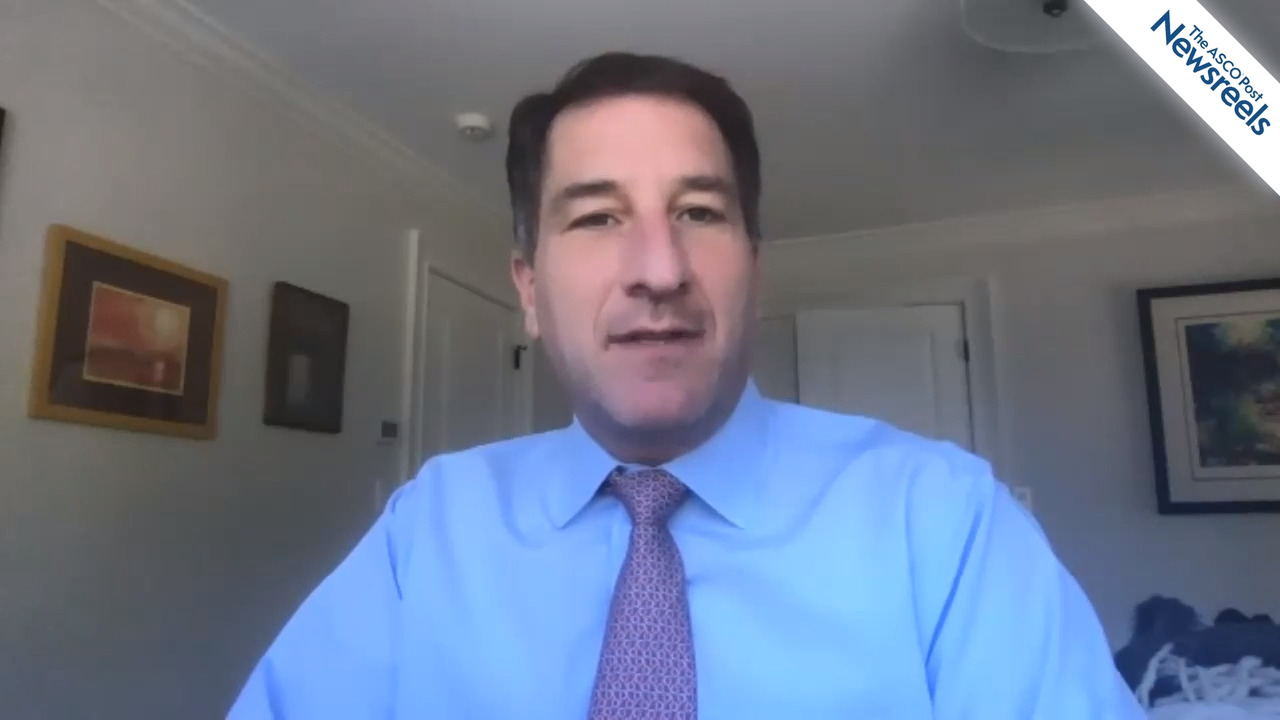
Roy S. Herbst, MD, PhD, on NSCLC: Osimertinib in Stage IB–IIIA EGFR Mutation–Positive Disease
ASCO20 Virtual Scientific Program
Roy S. Herbst, MD, PhD, of Yale Cancer Center, discusses data from the ADAURA study, which showed that compared with placebo, osimertinib as adjuvant therapy after complete tumor resection reduced the risk of disease recurrence or death by 79% in patients with non–small cell lung cancer (Abstract LBA5).
The ASCO Post Staff
Tingyan Shi, MD, PhD, of Zhongshan Hospital, Fudan University, discusses study results that showed secondary cytoreductive surgery in selected patients extended progression-free survival and might contribute to long-term survival (Abstract 6001).
The ASCO Post Staff
As Thomas Powles, MD, PhD, of Queen Mary University of London, prepares to deliver his late-breaking presentation at the ASCO20 Virtual Scientific Program (LBA-1), he talks with Christopher Sweeney, MBBS, of Dana-Farber Cancer Institute, about current therapy: PD1/PDL1 inhibition in second-line treatment and as monotherapy in the first-line setting, as well as the concept of maintenance switch.
The ASCO Post Staff
Jeffrey A. Meyerhardt, MD, MPH, of Dana-Farber Cancer Institute, discusses results from the CALGB/SWOG 80702 trial of celecoxib plus standard adjuvant therapy with fluorouracil, leucovorin, and oxaliplatin (FOLFOX). Adding celecoxib to standard chemotherapy did not significantly improve disease-free or overall survival (Abstract 4003).
The ASCO Post Staff
Christopher Nutting, MD, PhD, of the Royal Marsden Hospital and Institute of Cancer Research, discusses phase III results from the first study to demonstrate the functional benefit of swallow-sparing intensity-modulated radiotherapy in oro- and hypopharyngeal cancers (Abstract 6508).
The ASCO Post Staff
Nikhil C. Munshi, MD, of Dana-Farber Cancer Institute, discusses initial results from the KarMMa tria, showing that idecabtagene vicleucel, a B-cell maturation antigen-targeted CAR T-cell therapy, demonstrated deep and durable responses in patients with heavily pretreated relapsed or refractory multiple myeloma. Efficacy and safety data support a favorable clinical benefit-risk profile across the target dose range (Abstract 8503).