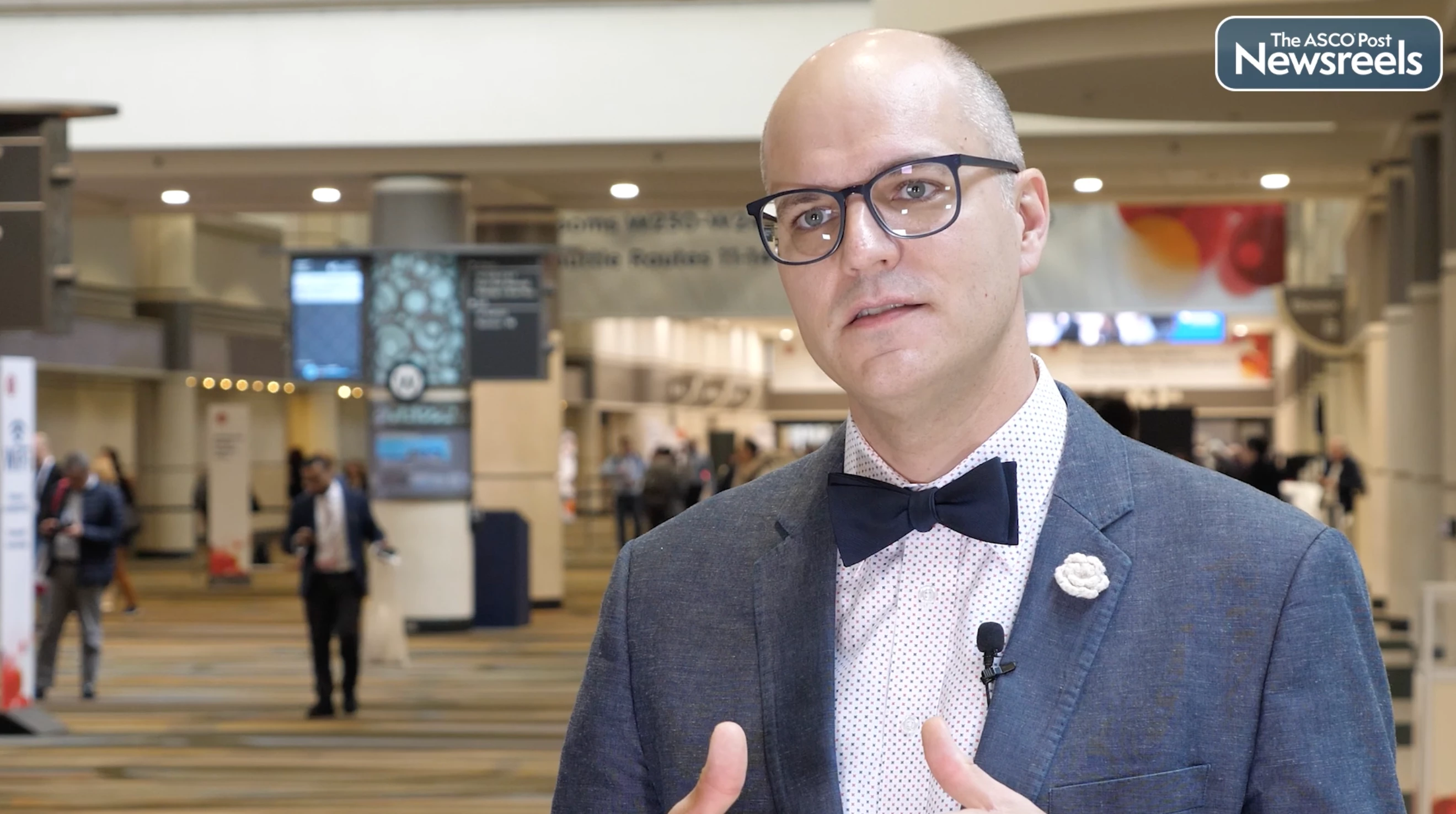
Benjamin Diamond, MD, on a Novel Quadruplet for Relapsed/Refractory Multiple Myeloma
ASH 2025
Benjamin Diamond, MD, of the University of Miami, describes findings from the single-center phase II REKINDLE trial, which looked at the combination regimen of iberdomide, carfilzomib, daratumumab, and dexamethasone in patients with early relapsed/refractory multiple myeloma (Abstract 251).
The ASCO Post Staff
Jennifer Woyach, MD, of The Ohio State University Comprehensive Cancer Center, reviews phase I data on rocbrutinib, a new selective next-generation inhibitor of Bruton’s tyrosine kinase (BTK), in patients with relapsed/refractory chronic lymphocytic leukemia (CLL) and prior exposure to BTK and/or BCL-2 inhibitors (Abstract 87).
The ASCO Post Staff
Jack Khouri, MD, of Cleveland Clinic, describes the findings of a phase II trial which investigated the safety and efficacy of burixafor (GPC-100), a potent and selective small -molecule antagonist of CXCR4, and propranolol with granulocyte colony-stimulating factor (G-CSF) for the mobilization of hematopoietic progenitor cells (HPC) in patients with multiple myeloma. Researchers aimed to boost the bone marrow HPC niche and optimize mobilization in patients with multiple myeloma eligible for autologous hematopoietic cell transplant (Abstract 1050).
The ASCO Post Staff
Jennifer Woyach, MD, of The Ohio State University Comprehensive Cancer Center, discusses results from the first head-to-head comparison of pirtobrutinib vs ibrutinib in treatment-naive patients and patients with covalent Bruton tyrosine kinase inhibitor–naive relapsed/refractory chronic lymphocytic leukemia/small lymphocytic lymphoma (CLL/SLL) (Abstract 683).
The ASCO Post Staff
Amer Zeidan, MBBS, of Yale School of Medicine, discusses findings from an analysis of the IMerge trial, which explored the possible association between imetelstat-related cytopenias and hemoglobin increase—a measure linked to red blood cell transfusion independence achievement—in patients with lower-risk myelodysplastic syndromes (MDS) (Abstract 490).
The ASCO Post Staff
Aaron Gerds, MD, of Cleveland Clinic, reviews results of an evaluation of Synapsis AI, a medically trained, large language model–based end-to-end system, focusing on its accuracy and efficiency in identifying eligible patients for an active phase III polycythemia vera clinical trial (Abstract 4340).