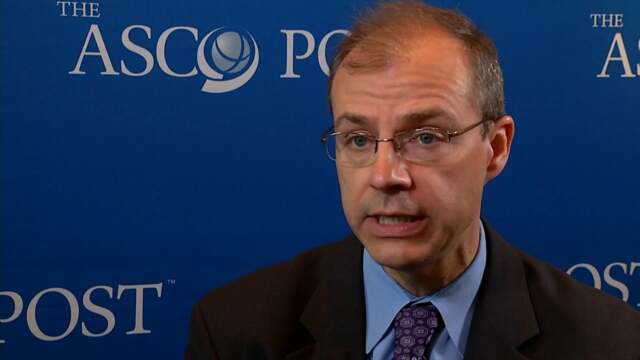
Jerald P. Radich, MD, on Treatment Milestones in CML: Stay the Course or Change Therapy?
2015 NCCN Annual Conference
Jerald P. Radich, MD, of the Fred Hutchinson Cancer Research Center and Seattle Cancer Care Alliance discusses the evolution in treating and monitoring CML and whether monitoring at 3 and 6 months will ultimately prove useful.
Mary Lou Smith, JD, MBA
Mary Lou Smith, JD, MBA, of the Research Advocacy Network, discusses, from the perspective of a patient advocate, the value of the NCCN guidelines and the impact they have made on cancer care.
Thomas A. D’Amico, MD
Thomas A. D’Amico, MD, of Duke Cancer Institute, discusses the superior efficacy of thoracoscopic lobectomy. This minimally invasive procedure is used in only 50% of lung cancer surgeries in the United States, in 30% of procedures in Asia, and in as few as 10% to 20% of procedures in Europe.
Anthony J. Olszanski, RPh, MD
Anthony J. Olszanski, RPh, MD, of the Fox Chase Cancer Center, discusses the advances in immunotherapy generally and for melanoma in particular.
Robert W. Carlson, MD, and William J. Gradishar, MD
Robert W. Carlson, MD, Chief Executive Officer, National Comprehensive Cancer Network, and William J. Gradishar, MD, Robert H. Lurie Comprehensive Cancer Center of Northwestern University, discuss the evolution of the breast cancer guidelines, the inclusion of varied fields––such as plastic surgery, pathology, patient advocacy, and radiation–– and new treatment changes.
Peter E. Clark, MD
Peter E. Clark, MD, of the Vanderbilt-Ingram Cancer Center discusses the highlights of the 2015 NCCN Guidelines for bladder cancer in both non–muscle invasive and muscle-invasive disease.