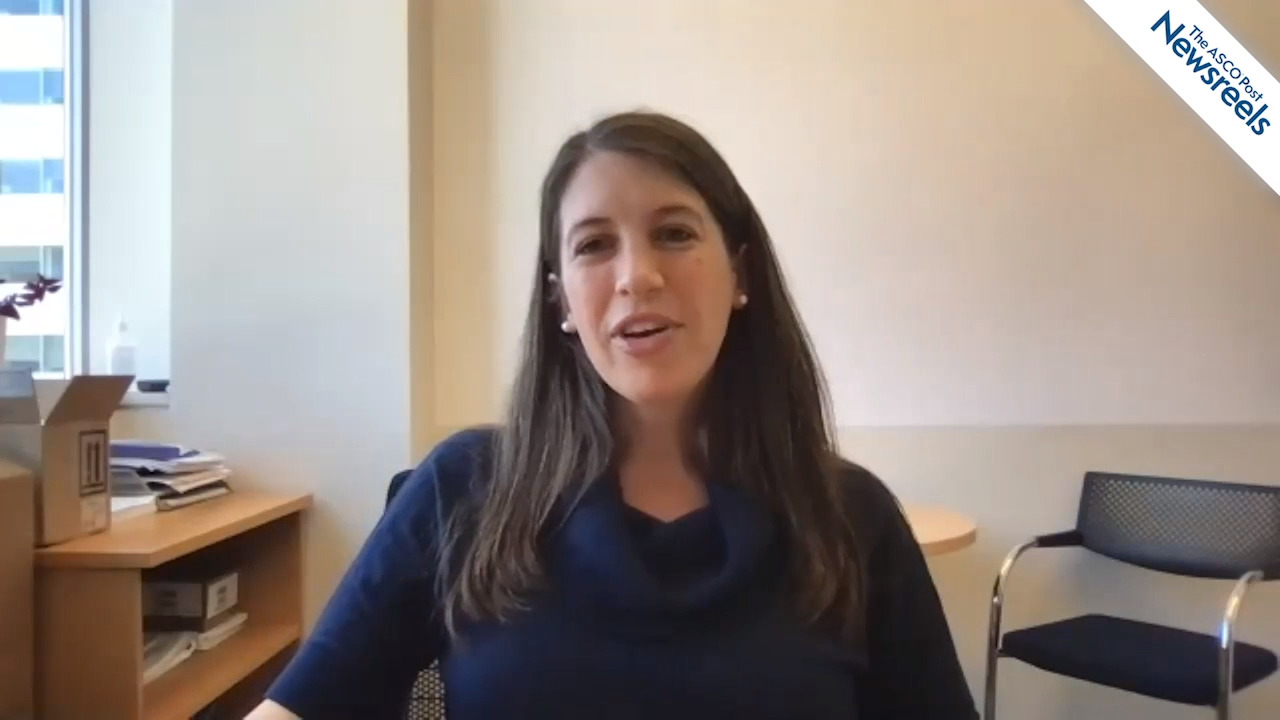
Richard S. Finn, MD, on Treating Hepatocellular Carcinoma With Atezolizumab, Bevacizumab, and Sorafenib
AACR Annual Meeting 2021
Richard S. Finn, MD, of UCLA Medical Center, discusses updated efficacy and safety data from the IMbrave150 trial of patients receiving atezolizumab plus bevacizumab vs sorafenib as first-line treatment for unresectable hepatocellular carcinoma (Abstract CT009).
The ASCO Post Staff
Joann G. Elmore, MD, MPH, of the UCLA Fielding School of Public Health, discusses previous studies that show wide variability in cancer diagnoses, the uncertainties introduced by computer-aided detection tools, and new research on artificial intelligence and machine learning that may lead to more consistent and accurate diagnoses and prognoses, potentially improving treatment (Abstract SY01-03).
The ASCO Post Staff
Katelyn T. Byrne, PhD, of the Perelman School of Medicine at the University of Pennsylvania, discusses the first in-depth analysis of the impact of selicrelumab, an anti-CD40 antibody, which was found to enrich T cells in pancreatic tumors, activate the immune system, and alter the tumor stroma (Abstract CT005).
The ASCO Post Staff
Linda T. Vahdat, MD, MBA, of Memorial Sloan Kettering Cancer Center, discusses results of a phase II trial designed to test the concept that targeting the tumor microenvironment by depleting copper may prevent metastases, essentially disrupting the infrastructure that contributes to tumor spread.
The ASCO Post Staff
Samra Turajlic, MBBS, PhD, of The Francis Crick Institute, discusses our limited understanding of metastases in terms of the timing of dissemination, the many metastatic phenotypes and varieties of seeding, as well as how the spread of cancer evades the immune system and resists treatment. Expanding this knowledge base is critical to better managing malignant disease.
The ASCO Post Staff
Charlotte E. Ariyan, MD, PhD, of Memorial Sloan Kettering Cancer Center, discusses improved outcomes with metastasectomy in the setting of checkpoint inhibitors, with the removal of residual disease and “escape” lesions. Surgical outcomes may also be better than targeted treatments, although long-term data and biomarkers are needed to confirm these findings.