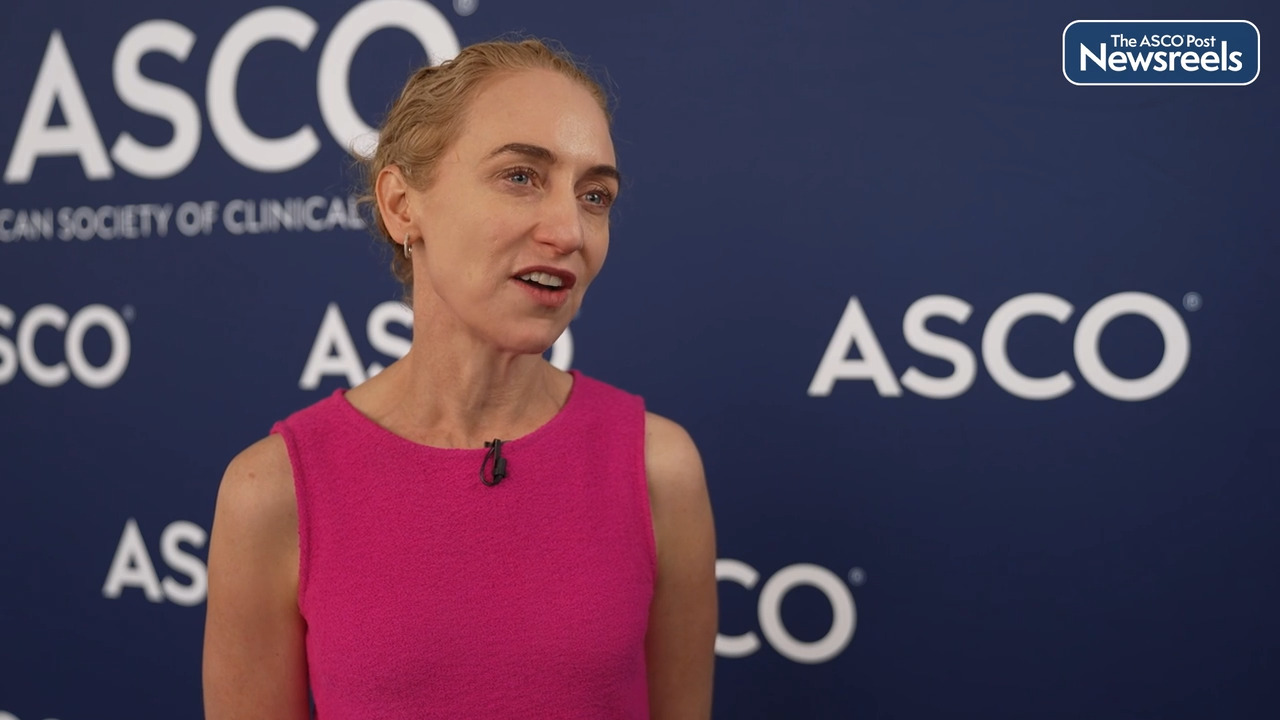
Ajay K. Nooka, MBBS, Relapsed or Refractory Multiple Myeloma: Efficacy and Safety Data for Elranatamab
2023 ASCO Annual Meeting
Ajay K. Nooka, MBBS, of Winship Cancer Center of Emory University, discusses findings from a pooled analysis of MagnetisMM studies. The data showed that, in patients with relapsed or refractory multiple myeloma who have not yet been treated with B-cell maturation antigen–directed therapies, elranatamab was efficacious and well tolerated.
The ASCO Post Staff
Lisa M. DeAngelis, MD, and Ingo K. Mellinghoff, MD, both of Memorial Sloan Kettering Cancer Center, discuss findings from the INDIGO trial showing that the IDH1/2 inhibitor vorasidenib improves progression-free survival for patients with residual or recurrent grade 2 glioma with an IDH1/2 mutation. These data demonstrate the clinical benefit of vorasidenib in this patient population for whom chemotherapy and radiotherapy are being delayed.
The ASCO Post Staff
Thierry Conroy, MD, of the Institut de Cancérologie de Lorraine, discusses phase III findings from the PRODIGE 23 trial, showing that neoadjuvant chemotherapy with mFOLFIRINOX followed by chemoradiotherapy, surgery, and adjuvant chemotherapy improved all outcomes, including overall survival, in patients with locally advanced rectal cancer compared with standard chemoradiotherapy, surgery, and adjuvant chemotherapy (Abstract LBA3504).
The ASCO Post Staff
Carmen E. Guerra, MD, MSCE, of the University of Pennsylvania Abramson Cancer Center, discusses three key abstracts presented at ASCO: strategies to increase accrual of underrepresented populations in Alliance NCTN trials, how patient-clinician education can strengthen partnerships and improve diversity in breast and lung cancer trials, and mediators of racial and ethnic inequities in clinical trial participation among U.S. patients with cancer from 2011 to 2022 (Abstracts 6509, 6510, 6511).
The ASCO Post Staff
Georgina V. Long, MD, PhD, of Melanoma Institute Australia and The University of Sydney, discusses new data showing that patients with resected stage IIB/C melanoma who were treated with adjuvant nivolumab had prolonged recurrence-free survival compared with placebo across all biomarker subgroups. The baseline biomarkers most predictive of prolonged recurrence-free survival with nivolumab were high interferon gamma score, high tumor mutational burden, CD8 T-cell infiltration, and low C-reactive protein (Abstract 9504).
The ASCO Post Staff
Amer Methqal Zeidan, MBBS, MHS, of Yale University and Yale Cancer Center, discusses phase III findings on the first-in-class telomerase inhibitor imetelstat, which was given to patients with heavily transfusion-dependent non-del(5q) lower-risk myelodysplastic syndromes that are resistant to erythropoiesis-stimulating agents. Imetelstat resulted in a significant and sustained red blood cell (RBC) transfusion independence in 40% of these heavily transfused patients. The response was also durable and accompanied by an impressive median hemoglobin rise of 3.6 g/dL, and seen in patients with and without ring sideroblasts. Importantly, reduced variant allele frequency was observed in the most commonly mutated myeloid genes which correlated with duration of transfusion independence and hemoglobin rise, therefore suggesting a disease-modifying potential of this agent (Abstract 7004).