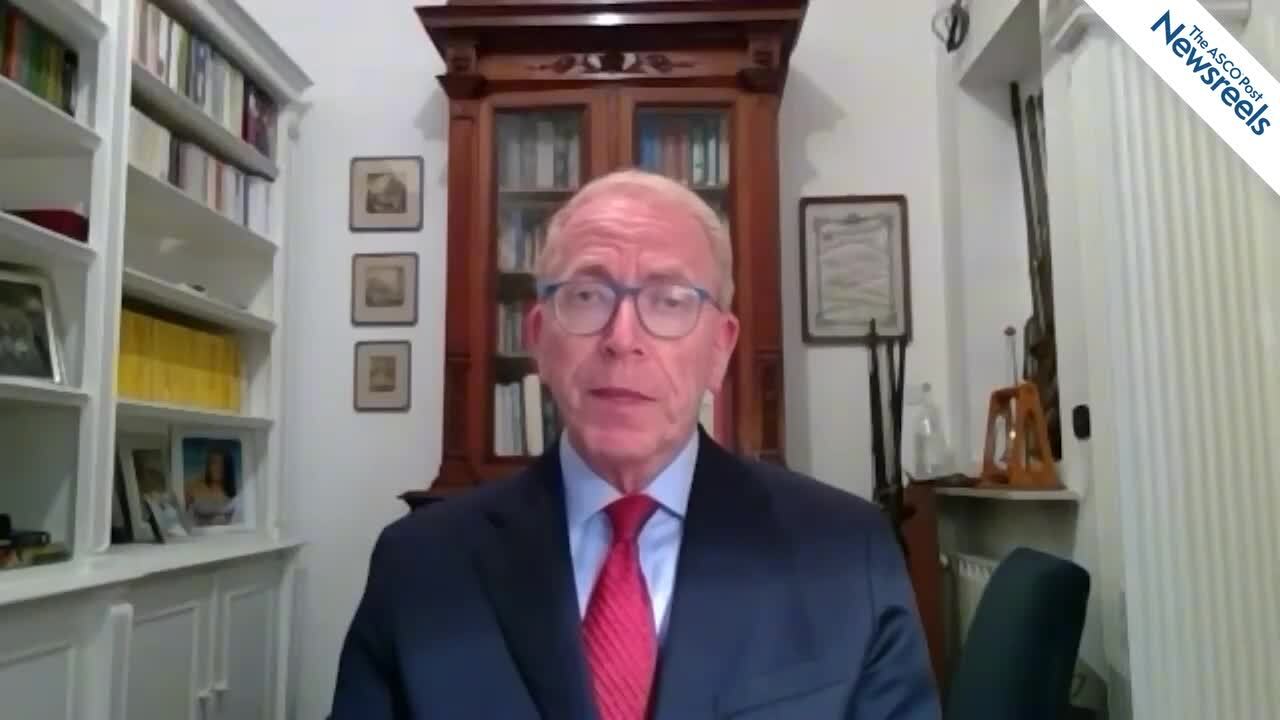
Christopher Nutting, MD, PhD, on Head and Neck Cancer: Dysphagia-Optimized vs Standard IMRT
ASCO20 Virtual Scientific Program
Christopher Nutting, MD, PhD, of the Royal Marsden Hospital and Institute of Cancer Research, discusses phase III results from the first study to demonstrate the functional benefit of swallow-sparing intensity-modulated radiotherapy in oro- and hypopharyngeal cancers (Abstract 6508).
The ASCO Post Staff
Alberto F. Sobrero, MD, of the Ospedale San Martino, discusses final results of the IDEA study, which supported the use of 3 months of adjuvant CAPOX, vs 6 months, for most patients with stage III colon cancer. The shorter treatment duration reduced toxicity, inconvenience, and cost (Abstract 4004).
The ASCO Post Staff
Patricia Pautier, MD, of Institut Gustave Roussy, discusses final results of the phase II LMS-02 study, which showed the combination of doxorubicin and trabectedin to be an effective first-line therapy for patients with leiomyosarcoma, with an acceptable safety profile (Abstract 11506).
The ASCO Post Staff
Parameswaran Hari, MD, of the Medical College of Wisconsin, discusses data from four trials and their clinical implications for the treatment of patients with multiple myeloma: the KarMMa and EVOLVE studies on CAR T cell therapies; SWOG-1211 on bortezomib, lenalidomide, and dexamthasone with/without elotuzumab for newly diagnosed, high-risk disease; and the GMMGCONCEPT trial on isatuximab, carfilzomib, lenalidomide, and dexamethasone in front-line treatment (Abstracts 8503, 8504, 8507, 8508).
The ASCO Post Staff
Jeremy L. Warner, MD, of Vanderbilt-Ingram Cancer Center, discusses data from the COVID-19 and Cancer Consortium cohort study, which included patients with active or prior hematologic or invasive solid malignancies, reported across academic and community sites (Abstract LBA110).
The ASCO Post Staff
Peter Reichardt, MD, PhD, of Helios Klinikum Berlin-Buch, discusses the 10-year survival analysis of 3 years vs 1 year of adjuvant imatinib for patients with high-risk gastrointestinal stromal tumor. The study found that about 50% of deaths can be avoided with longer imatinib treatment (Abstract 11503).