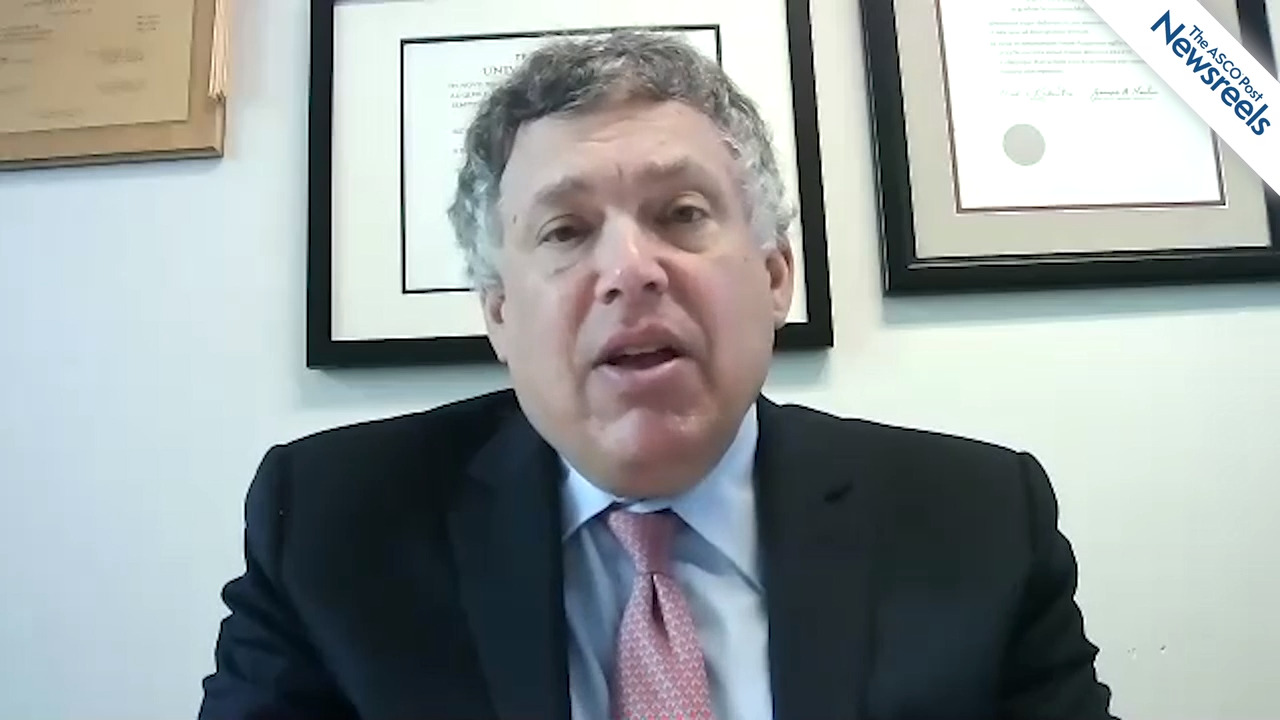
Eric Jonasch, MD, on a Novel Therapy for Von Hippel-Lindau Disease–Associated RCC
ASCO20 Virtual Scientific Program
Eric Jonasch, MD, of The University of Texas MD Anderson Cancer Center, discusses phase II study findings on the oral HIF-2α inhibitor known as MK-6482, which showed efficacy and tolerability in patients with Von Hippel-Lindau (VHL)–associated clear cell renal cell carcinoma as well as responses in other VHL-related lesions (Abstract 5003).
The ASCO Post Staff
Paul G. Richardson, MD, of Dana-Farber Cancer Institute, discusses early results on a cereblon E3 ligase modulator agent combined with dexamethasone in patients with relapsed or refractory multiple myeloma, with an overall response rate of 48%. The study is ongoing to further optimize dose and schedule (Abstract 8500).
The ASCO Post Staff
Reshma Jagsi, MD, DPhil, of the University of Michigan, and Narjust Duma, MD, of the University of Wisconsin Carbone Cancer Center, discuss the state of diversity in the hematology-oncology workforce, mechanisms that lead to inequities, promising interventions, and where the field should go next (Abstract 11000).
The ASCO Post Staff
Ursula A. Matulonis, MD, of Dana-Farber Cancer Institute, discusses three important studies focusing on newer therapies for patients with recurrent platinum-sensitive, platinum-agnostic, and advanced recurrent ovarian cancers (Abstracts 6003, 6004, and 6005).
The ASCO Post Staff
David R. Wise, MD, PhD, of New York University Perlmutter Cancer Center, summarizes three important studies in prostate cancer: circulating tumor cell count as a prognostic marker of PSA response and progression in metastatic castration-sensitive disease; new phenotypic subtypes; and how circulating tumor DNA dynamics associate with treatment response and radiologic progression-free survival (Abstracts 5506, 5507, and 5508).
The ASCO Post Staff
Roy S. Herbst, MD, PhD, of Yale Cancer Center, discusses data from the ADAURA study, which showed that compared with placebo, osimertinib as adjuvant therapy after complete tumor resection reduced the risk of disease recurrence or death by 79% in patients with non–small cell lung cancer (Abstract LBA5).