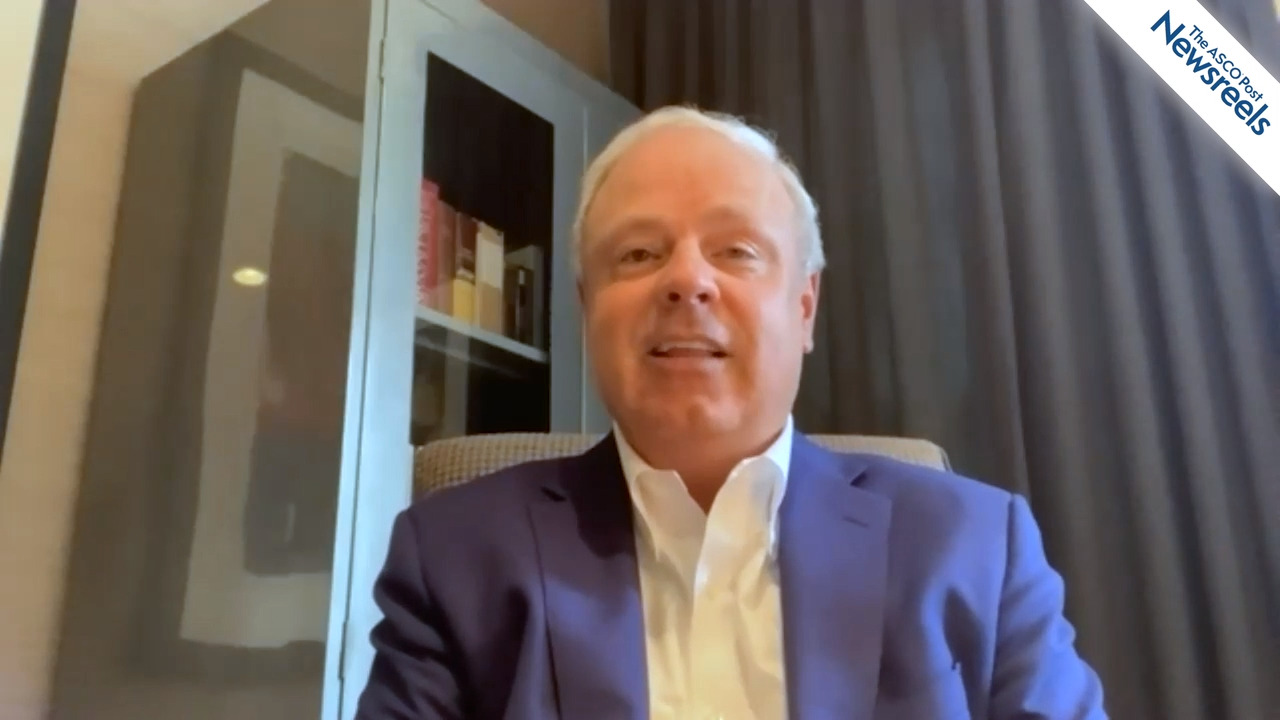
David C. Fajgenbaum, MD, MBA, on Chasing His Cure: A Physician Is Battling His Disease and Beating the Odds
ASCO20 Virtual Scientific Program
David C. Fajgenbaum, MD, MBA, of the University of Pennsylvania, who trained as an oncologist, summarizes his opening lecture, a dramatic story of his battle against Castleman, a disease of the lymph nodes, his multiple near-death experiences, and the path that led him to develop a cooperative research effort making a difference for him and other patients with this idiopathic orphan illness.
The ASCO Post Staff
Christopher Sweeney, MBBS, of Dana-Farber Cancer Institute, talks with Thomas Powles, MD, PhD, of Queen Mary University of London, about the first study to demonstrate a survival advantage with avelumab for metastatic urothelial cancer. In the trial, avelumab improved median overall survival by 21.4 months compared with 14.3 months with best supportive care (Abstract LBA1).
The ASCO Post Staff
Howard A. Burris III, MD, FACP, FASCO, Immediate Past President of ASCO and current Society Board Chair, talks about how the meeting went, with its record-breaking attendance and new format.
The ASCO Post Staff
Sarah A. Holstein, MD, PhD, of the University of Nebraska Medical Center, discusses top myeloma abstracts from the ASCO20 Virtual Scientific Program: the ENDURANCE trial on carfilzomib, lenalidomide, dexamethasone, and bortezomib; the STaMINA study on transplantation strategies; a first-in-human study on the novel CELMoD agent CC-92480 plus dexamethasone; the CARTITUDE-1 trial on CAR T-cell therapy; and a phase I study of teclistamab (Abstracts LBA3, 8506, 8500, 8505, and 100).
The ASCO Post Staff
Peter Reichardt, MD, PhD, of Helios Klinikum Berlin-Buch, discusses the 10-year survival analysis of 3 years vs 1 year of adjuvant imatinib for patients with high-risk gastrointestinal stromal tumor. The study found that about 50% of deaths can be avoided with longer imatinib treatment (Abstract 11503).
The ASCO Post Staff
Christopher Nutting, MD, PhD, of the Royal Marsden Hospital and Institute of Cancer Research, discusses phase III results from the first study to demonstrate the functional benefit of swallow-sparing intensity-modulated radiotherapy in oro- and hypopharyngeal cancers (Abstract 6508).