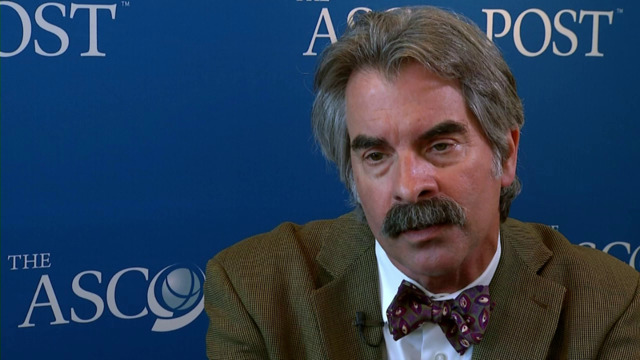
Andrew J. Armstrong, MD, ScM, on New Treatment Options in Castration-Resistant Prostate Cancer
2015 NCCN Annual Conference
Andrew J. Armstrong, MD, ScM, of Duke Cancer Institute, discusses the recent practice-changing landmark studies that showed significant increases in survival for men with castration-resistant prostate cancer and led to updates in the NCCN Guidelines for this disease.
Robert W. Carlson, MD, and John A. Gentile, Jr
Robert W. Carlson, MD, Chief Executive Officer, National Comprehensive Cancer Network, and John A. Gentile, Jr, Chairman, Harborside Press, LLC, discuss the early days of NCCN, controversies that surrounded the first meeting, oncologists’ embrace of the guidelines, and how the organization has evolved over the past 20 years.
Thomas A. D’Amico, MD
Thomas A. D’Amico, MD, of Duke Cancer Institute, discusses the superior efficacy of thoracoscopic lobectomy. This minimally invasive procedure is used in only 50% of lung cancer surgeries in the United States, in 30% of procedures in Asia, and in as few as 10% to 20% of procedures in Europe.
Kenneth C. Anderson, MD
Kenneth C. Anderson, MD, of Dana-Farber/Brigham and Women’s Cancer Center, discusses the incredible progress made in treating multiple myeloma, with nine therapeutic options approved in the past decade, two drugs approved this year, and a number of new options on the horizon.
Samuel M. Silver, MD, PhD, and Al B. Benson III, MD, FACP, FASCO
Samuel M. Silver, MD, PhD, of the University of Michigan Comprehensive Cancer Center, and Al B. Benson III, MD, FACP, FASCO, of Robert H. Lurie Comprehensive Cancer Center of Northwestern University, discuss the evolution of NCCN Guidelines, which are available free online, and the components that make them effective: a multidisciplinary approach, the participation of patient advocates, consistency, and affordability of the evidence.
Jerald P. Radich, MD
Jerald P. Radich, MD, of the Fred Hutchinson Cancer Research Center and Seattle Cancer Care Alliance discusses the evolution in treating and monitoring CML and whether monitoring at 3 and 6 months will ultimately prove useful.