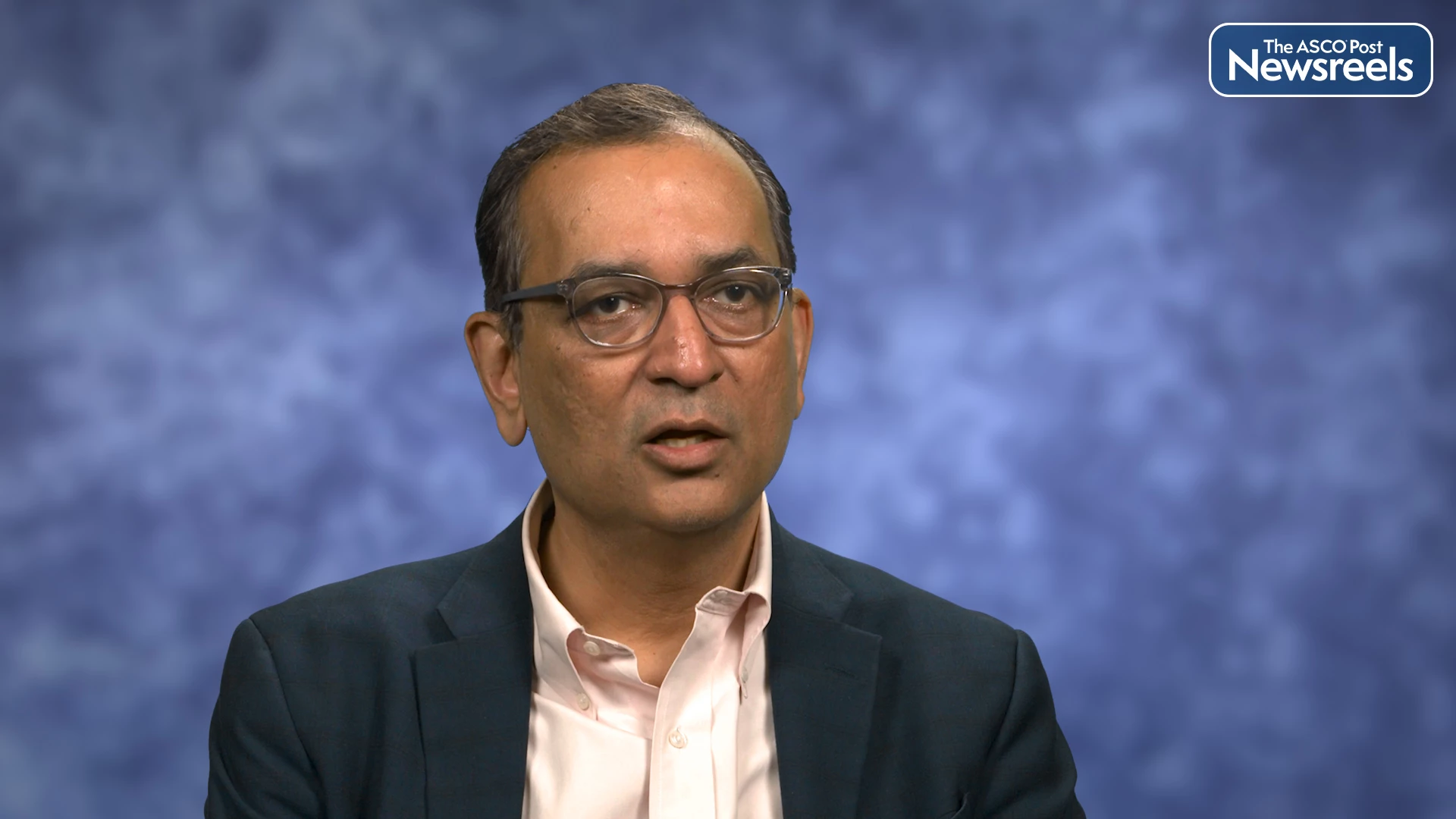
Van K. Morris, MD, on Colon Cancer: ctDNA as a Predictive Biomarker
2024 ASCO GI Cancers Symposium
Van K. Morris, MD, of The University of Texas MD Anderson Cancer Center, discusses phase II results on using circulating tumor DNA (ctDNA) as a predictive biomarker of adjuvant chemotherapy in patients with stage II colon cancer. During the trial, no improvement in ctDNA clearance was observed after 6 months of chemotherapy following resection of disease. Dr. Morris notes that future trials should account for evolving assay performance in patients with colorectal cancer (Abstract 5).
The ASCO Post Staff
Jennifer Yon-Li Wo, MD, of Massachusetts General Hospital, discusses the local failure rate of non-ablative hypofractionated radiation therapy in combination with the immune checkpoint inhibitors ipilimumab and nivolumab compared to ablative SBRT to treat metastatic microsatellite-stable colorectal and pancreatic cancers as a secondary analysis of four prospective trials. Dr. Wo and her team found that, despite using nearly half the radiation dose in those who received immunotherapy, there was no significant difference in local failure rates (Abstract 752).
The ASCO Post Staff
Michael K. Gibson, MD, PhD, of Vanderbilt University Medical Center, discusses phase III findings on chemotherapy plus camrelizumab in the ESCORT-NEO trial of patients with resectable esophageal squamous cell carcinoma; and phase III SKYSCRAPER-08 results on first-line tiragolumab plus atezolizumab and chemotherapy in the same patient population (Abstracts LBA244 and 245).
The ASCO Post Staff
Dominik P. Modest, MD, of Charité-Universitätsmedizin Berlin, discusses phase III study findings showing sotorasib plus panitumumab vs trifluridine/tipiracil or regorafenib benefits patients with chemorefractory metastatic colorectal cancer in terms of improved clinical outcomes and better self-reported quality of life (Abstract 10).
The ASCO Post Staff
Ken Kato, MD, PhD, of Japan’s National Cancer Center Hospital, discusses the first comprehensive findings on biomarkers from the CheckMate 648 study. These results further corroborate the clinical efficacy of nivolumab plus chemotherapy and nivolumab plus ipilimumab in the first-line treatment of advanced esophageal squamous cell carcinoma. According to Dr. Kato, the data suggest an overall survival benefit across multiple biomarker subgroups (Abstract 252).
The ASCO Post Staff
Milind M. Javle, MD, of The University of Texas MD Anderson Cancer Center, discusses phase II results on tinengotinib, a next-generation FGFR inhibitor that seems to overcome acquired resistance and shows efficacy in patients with cholangiocarcinoma with other FGFR alterations who are not eligible for FGFR2-targeted treatments. A phase III global study is currently enrolling to further evaluate the efficacy and safety of this agent vs physician’s choice in FGFR-altered, chemotherapy- and FGFR-inhibitor–refractory or relapsed disease.