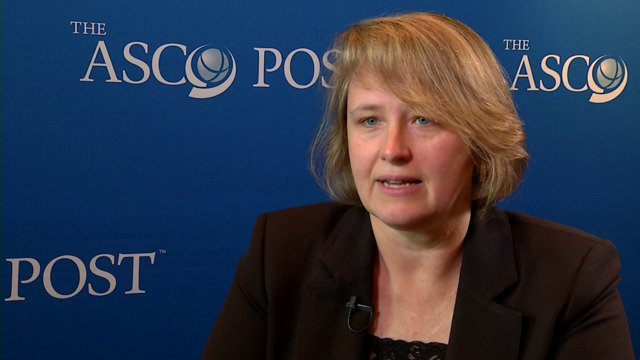
Ingrid A. Mayer, MD, on New Therapies for Hormone-Sensitive Advanced Breast Cancer
2015 NCCN Annual Conference
Ingrid A. Mayer, MD, of the Vanderbilt-Ingram Cancer Center, discusses the evolution of endocrine therapy for metastatic breast cancer.
Jerald P. Radich, MD
Jerald P. Radich, MD, of the Fred Hutchinson Cancer Research Center and Seattle Cancer Care Alliance discusses the evolution in treating and monitoring CML and whether monitoring at 3 and 6 months will ultimately prove useful.
Peter E. Clark, MD
Peter E. Clark, MD, of the Vanderbilt-Ingram Cancer Center discusses the highlights of the 2015 NCCN Guidelines for bladder cancer in both non–muscle invasive and muscle-invasive disease.
Andrew D. Zelenetz, MD, PhD
Andrew D. Zelenetz, MD, PhD, of Memorial Sloan Kettering Cancer Center, talks about the revolution in lymphoma treatment, which started with rituximab and continues with obinutuzumab, ibrutinib, and others.
Eric Jonasch, MD
Eric Jonasch, MD, of The University of Texas, MD Anderson Cancer Center, discusses the progress being made in kidney cancer treatment and the clinical trials that focused on sunitinib, sorafenib, and everolimus, among others.
Rebecca H. Johnson, MD
Although guidelines worldwide mandate fertility preservation for newly diagnosed patients within their reproductive window, most patients are still not referred or offered this option. Rebecca H. Johnson, MD, of Mary Bridge Children’s Hospital, explains the steps that need to be taken when counseling patients.