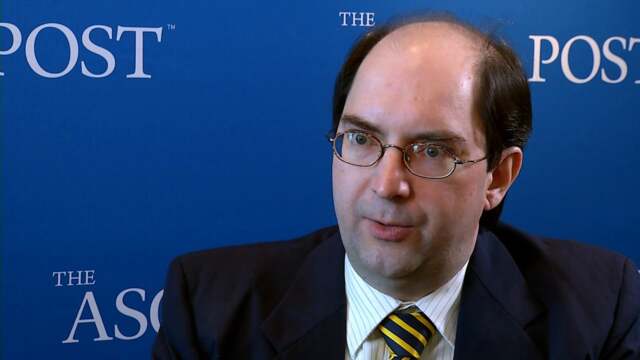
Andrew J. Armstrong, MD, ScM, on New Treatment Options in Castration-Resistant Prostate Cancer
2015 NCCN Annual Conference
Andrew J. Armstrong, MD, ScM, of Duke Cancer Institute, discusses the recent practice-changing landmark studies that showed significant increases in survival for men with castration-resistant prostate cancer and led to updates in the NCCN Guidelines for this disease.
Andrew D. Zelenetz, MD, PhD
Andrew D. Zelenetz, MD, PhD, of Memorial Sloan Kettering Cancer Center, talks about the revolution in lymphoma treatment, which started with rituximab and continues with obinutuzumab, ibrutinib, and others.
Axel Grothey, MD
Axel Grothey, MD, of the Mayo Clinic Cancer Center, discusses how the NCCN Guidelines can help oncologists make strategic choices of the various agents available to treat metastatic colorectal cancer, individualizing patient care.
Wui-Jin Koh, MD
Wui-Jin Koh, MD, of the Fred Hutchinson Cancer Research Center and the Seattle Cancer Care Alliance, discusses the program to adapt NCCN guidelines to regions of the world with different resource availability. The first guideline to be adapted in this way is for cervical cancer, which is prevalent in the developing world.
John A. Thompson, MD
John A. Thompson, MD, of the Fred Hutchinson Cancer Research Center and Seattle Cancer Care Alliance, discusses the latest immunotherapeutics for advanced melanoma, including pembrolizumab, trametinib, nivolumab, and dabrafenib.
John C. Grecula, MD
John C. Grecula, MD, of The Ohio State University Comprehensive Cancer Center and the James Cancer Hospital and Solove Research Institute, discusses the evolution of precision delivery of radiation for patients with small cell lung cancer and advances that include prophylactic cranial radiotherapy, thoracic radiotherapy, and the use of PET-CT.